successor to Shock and Awe whose feed no longer seems to be working properly - original blog + archive remains here: http://shockandawesimonreynolds.blogspot.com/ ^^^^^^^^^^^^^^^^ the blog of the Simon Reynolds book about glam and artpop of the 1970s and its aftershocks and reflections to this day
"Duel" / "Jewel" the only time Propaganda really swayed me
A beautiful melody, written to suit Claudia's voice, no strain, and the product is, well, cut-glass
"Duel / Jewel" run on as on the album A Secret Wish
Cut Rough / Rough Cut - is there a difference?
The other one was originally meant to be the singer but Trevor Horn insisted Claudia do it as the other one was not up to the job
Eye to eye, stand winners and losers
Hurt by envy, cut by greed
Face to face with their own disillusion
The scars of old romances still on their cheeks
And when blow by blow
The passion dies sweet little death
Just have been lies, some memories of gone by time
Would still recall the lies
The first cut won't hurt at all
The second only makes you wonder
The third will have you on your knees
You start bleeding I start screaming
It's too late the decision is made by fate
Time to prove what forever should last
Whose feelings are so true as to stand the test?
Whose demands are so strong as to parry all attempts?
And when blow by blow
The passion dies sweet little death
Just have been lies, some memories of gone by time
Would still recall the lies
The first cut won't hurt at all
The second only makes you wonder
The third will have you on your knees
You start bleeding I start screaming
S+M bondage Skin 2 fetish wear and all sortsa kink were kind of hip in the early 80s... that sort of pomo postfeminist moment
The glassy yet brutal sound and crashy drums seems to anticipate Jam City Classical Curves and SOPHIE "Faceshopping"
Glitter shards to cut your face to ribbons
Classical Curves was “a record about being repulsed and fascinated by the glossy surfaces of a certain 'high-end', hyper-capitalist consumer society”
e.g. “Her” with its robo chant and sounds like a battery of camera flashes "Work work work flash / Work work camera flash work / Work camera flash / Work work work flash". Poses being struck as blows struck to the eye...
Obliquely inspired by ballroom and vogueing I should imagine
Back to Propaganda...
Mr Brücken has a go at remixing
I should imagine it was Morley's idea to cover Josef K's "Sorry for Laughing", direct some money towards one of his favorite writers, Paul Haig
The Unapologetic Mix, haha
Everyone involved should apologize for that version
A live version
Later career is the definition of Wiki Fizzle (trust me, don't look)
but...
I was oh so prepared for this to be terrible but it's actually rather good
Claudia's got good taste - this is my favorite song by The Band and it's quite a sensitive treatment
The Band are about as anti-glam as it gets it, funnily enough.
SOPHIE's posthumous album SOPHIE is out now on Transgressive and Future Classic - and there's some great stuff on it.
An interesting piece at the New Yorker by Jia Tolentino looking at SOPHIE's career and work in terms of "plasticity"
On "Bipp"
"black space latticed with radically strange objects: a rubbery squelch of a bass beat, a melodic line like a laser coated in latex, percussive punctuation marks that seemed to morph from plasma into steel."
On SOPHIE'S early interviews:
"She’d picked the name Sophie, she said, because it “tastes good and it’s like moisturizer.” Her influences were “shopping, mainly.” She wondered if music could work like a theme-park roller coaster, leaving you nauseated and laughing, then leading you to purchase a key ring."
On SOPHIE'S process:
"Nothing else sounded like Sophie, because she made her sounds from scratch. She didn’t sample; she built each hiss and smack and boom by manipulating raw waveforms. She wanted to get to the “molecular level of a particular sound,” to understand why that sound “behaves a certain way when processed or cooked.”
On SOPHIE's ethos:
"There was a sense that transformation was the point and the teleology; Sophie’s sonic plasticity pointed to interrelational reinvention, toward a truth that had to be formed in the primordial tide pool of a dark, pulsing room...... She had translated her life and her questions into these new sounds, evincing some personal ethic of the transhuman and the trans human, in which states of flux could be captured in digital permanence, in which alteration was how you approached the divine".
^^^^^^^^^^^^^^^^
As I have said before here, if any artist could have had a lengthy entry in the "Aftershocks" section of Shock and Awe, it would be SOPHIE. Below are my thoughts about "Faceshopping" and Oil of Every Pearl's Un-Insides
"Faceshopping" is a digi-glam tour de force.
Here's what I said about the video-single in the infamous C-tronica piece:
"The 2018 song and video works simultaneously as a critique and a celebration of the idea of self-as-brand, drawing inspiration equally from 21st century social media and from the tradition of flamboyant display in ballroom and drag. A digital simulacrum of Sophie’s face—already a stylized mask of makeup—is shattered and reconstituted using computer-animation effects.
Further thoughts:
... What intrigued me about SOPHIE is this collision of extreme exteriority but then still a lingering belief in the idea of interiority.
In interviews, SOPHIE sometimes used the words "authentic" and "authenticity" as positive terms
Some say that the album title Oil of Every Pearl's Un-Insides is intended to be read phonetically - "I love every person's insides"
An idea continued on the album's other single "It's Okay To Cry", which contains the line "I think your inside is your best side"
Again playing on the contradiction between exteriority and interiority: the photographable pose ("your best side") versus deep hidden truth ("your inside").
Between selfie and self.
Tears as a tear in the 2D image presented to the world. The abject inside leaking out.
The Superflat SuperSelf. Surface as Shield. An inscrutable mask.
So there's a tension that is unresolved between the allure of digi-glamour (creating doctored images - selfies or videoworks - and disseminating them for unknown eyes) and a lingering longing to be real, to be unprotected and honestly vulnerable, nakedly pathetic even. Because the truth is always weakness and damage.
That is further enacted in the songs not just thematically but in the sound itself - a combo of super-glistening surface sheen and hyper-contoured sounds versus messy splurges of sound and tearing, shredding percussion....
The immaculate versus maculate (the latter sound-palette evocative of stress, abjection, fragility, torsion).
A sonic dramatization of a fraught mental space caught between the opposed demands of exteriority versus interiority .. expressive also of an unresolved tension between the idea of the self as performative and constructed versus the idea of identity as innate and fated.
"Dramatization" is the word - with the kind of music made by SOPHIE and others, there's a feeling that the music is staged. You don't immerse yourself in the sound, lose yourself in it; you almost look at it. It enthralls you, but you remain external to it, at a distance: watching it as a sonic spectacle. A ceremony.
That's why the phrase "tour de force" feels right. It's hard for me to imagine someone listening to "Faceshopping" in a habitual sort of way. It's too imposing. More like a show, an event to experience rather than something that can accompany everyday activity.
A flagellant pageant of ritual rhythm.
The opening salvo of lyric, as delivered by Cecile Believe -
My face is the front of shop
My face is the real shop front
My shop is the face I front
I'm real when I shop my face
- also makes me think of a book I read for S+A: Erving Goffman’s 1959 study of social life as theatre The Presentation of Self in Everyday Life, in which he formulated concepts like “impression management” and the “personal front.”
The song is a deeply ambivalent commentary on the culture of art-I-fice and self-selling - identity as product.
Today's digi-glamorous Instaglam spaces - a honeycomb hall of mirrors infinity infested by influencers (people paid to be seen - seen with products) - is like a decentralized and democratic version of the royal court. A placeless place to be, a poser's paradise. A festival of facades. (No wonder that the courtly world loved nothing more than a masquerade).
References to pearls and glam(our) inevitably makes me think of this song:
Me on "Mother of Pearl":
"Just as “Every Dream Home” has a religious undertow, “Mother of Pearl” references goddesses and the Holy Grail. But the most significant aspect of the song is the choice of mother of pearl as the trope of perfection (as opposed to diamonds or gold).The subliminal association is with the Virgin Mother: the whole song revolves around the madonna/whore dichotomy. Mother of pearl, also known as nacre, is an iridescent substance generated by particular species of oyster and other slimy mollusks. Nacre is found on the inside of the shell, or on the outer surface of pearls. This pearlescent shimmer-stuff is a real-world analogue for glamour: an optically dazzling patina produced by an abject, formless biological interior. Virtually imperishable, nacre exists right on the edge between the organic and inorganic, the mortal and the deathless. It suggests that there is something life-denying, or least life-freezing, about glamour. Reversing William Blake’s dictum that “exuberance is beauty,” glamour replaces liveliness with a cold, still perfection: the pose, the photograph."
^^^^^^^^^^^^^
Thought for an essay: contrasting Poly Styrene and SOPHIE, 1970s rad-feminism and 2010s xenofeminism, "when I put on my make-up / the pretty little mask's not me" versus "Scalpel, lipstick, gel /action, camera, lights"
Art-I-Ficial
On X-Ray Spex and Poly in S+A:
"Marianne Elliott-Said picked Poly Styrene as her name as a “a
send up of being a pop star... like a little figure, not me... a lightweight
disposable product... that’s what pop stars are meant to be”. There’s an echo
here of Bowie’s “plastic soul” and Ziggy as “plastic rocker”. As is the case with much punk,
glam-turned-inside-out is what you get on the glorious Germfree Adolescents:
tunes like “Art-I-Ficial” cry out with a sort of jubilant bitterness,
Poly unloosing her emptiness vengefully upon a world that has made her
generation inauthentic and soul-less. “Obsessed With You” blasts
advertisers for whom every kid is “just another figure for the sales machine,”
but also the impressionable, moldable kids; “I Am A Cliché”' and “I Am A
Poseur” reflect back at society its own worst nightmare of youth-gone-wrong.
“Let’s Submerge” and “Warrior In Woolworths” lampoon the concepts of rebellion
and the underground on which punk itself is based. “The Day The World Turned
Day-Glo” and “Plastic Bag” are hallucinatory consumer phantasmagorias - “I eat
Kleenex for breakfast and use soft hygienic Weetabix to dry my tears,” “1977
and we are going mad! 1977 and we've seen too many ads!”- like “Virginia
Plain” soured and psychotic.
"Identity is the crisis can't you see..."
^^^^^^^^^^^^^^^^^^^^^^^^^^^^^^
Related fragment:
"Fueled by narcissism, our century’s great motivator, the hipster inflicted himself upon the world by way of his affinities, his special brands of choice. Then we bypassed the middleman and became the brands ourselves. “Life has become a performance, a rather banal and meaningless one. That may have been the case for centuries, but even more so now,” wrote Dean Kissick for Spike Magazine in 2021. “The only thing we can make now is ourselves; day after day, again and again.” Not only is this life of endless bonsai-pruning one’s public-facing persona bleak on its own terms, it also comes at the expense of real and lasting art. Today’s avant-garde make memes or podcasts; they generate discourse; they post."
Recently I watched this fascinating documentary The Disappearance of Shere Hite, about the sex researcher and best-selling author.
I only had a vague sense of Shere Hite prior to watching the doc. Faint memories of two books: the famous one, The Hite Report: A Nationwide Study of Female Sexuality, a multi-million-selling, translated-into-dozens-of-language smash success on publication in 1977; and then the not-so-good-seller sequel about male sexuality published in 1981. I knew that she fit somewhere in that lineage of sexologists who shocked the strait-laced with their discoveries, alongside Havelock Ellis, Alfred Kinsey, and Masters & Johnson.
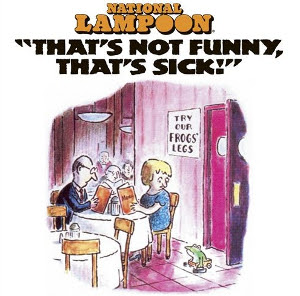
But really the main thing that comes to mind - and "come" is the operative word - is "Hite Report Disco", a raunchy spoof song that appeared on National Lampoon's That's Not Funny, That's Sick - arisqué comedy album my brother bought and which got played endlessly in our house. Such that many of the sketches I can remember word for word. I could certainly replicate the way the just-post-orgasmic man in "Hite Report Disco" says "grrrrrreat!!!" and the aggrieved tone of his unfulfilled lover muttering "great for you maybe".
(Although listening to the song again, the National Lampoonists have failed to grasp the import of Hite's discoveries - the unsatisfied woman in "Hite Report Disco" really ought to take business into her own hands if she wants results)
The most striking thing about this documentary is not the disappearance aspect (her fading from fame and what followed). It's, well, the appearance of Shere Hite.
You expect some kind of fairly frumpy scientist - unconcerned with the fripperies of personal appearance - or at most someone respectably dressed in reasonably smart professional clothing.
But instead here's this absolute glamour queen clad in clothes that are decidedly
un-1970s, harking back to some much earlier idea of elegance and chic.
With her creamy complexion, piercing blue eyes, tall and willowy figure, and cloud of strawberry blonde hair, Hite looks like a Fassbinder heroine.
The name "Shere Hite" itself seems like some quintessence of glamour - "sheer" indeed.
It's like a movie star name, from the 1940s.
Even in her early pre-fame days, when she was struggling to make ends meet, Hite loved to surround herself with exquisite things - beautiful clothes, beautiful decor, beautiful furniture and ornaments and pictures.... all in a style of opulent luxuriousness dating back well before mid-century modern aesthetics... back to the Golden Age of Hollywood - the sort of dated sense of elegance and feeling for the "finer things in life" you'd associate with Norma Desmond.
I don't recall it being mentioned in the doc, but I'm sure Hite loved perfume - she must have wafted behind her the heady scent of the most classic and expensive fragrances
In the early days of her research, which was under-resourced but expensive, involving the mailing out of thousands of surveys and then the painstaking collating of the highly detailed data that arrived in response to the large number of questions... in order to keep herself subsisting (and perhaps also maintain some of her expensive habits), Hite worked as a fashion model.
She also was a life model for the illustrator Robert McGinnis, a collectable cult figure renowned for his movie posters and pulp paperback covers. Hite has been described as McGinnis's muse: she was his favorite model and her posed image proliferated in endless painted variations as the stylized glamour girl on the front of all kinds of romance, crime, and spy novels.... the kind of pink or orange edged paperbacks you used to find at airports or in the rotating racks of a convenience store or gas station....
Yet despite not just propagating - but clearly being personally enamored with - all these increasingly behind-the-times and reactionary images of femininity (the very sort of imagery and archetypes that Betty Friedan and German Greer, with The Feminine Mystique and The Female Eunuch respectively, wished to demolish) - despite posing for Playboy... Hite was a committed feminist, involved in the women's liberation movement via N.O.W.... a participant in demonstrations and activism... and independent-mindedly and determinedly dedicated to her research into female sexuality,
That work was demystification in the Our Bodies, Ourselves mode - about exposing the
graphic genital truth of female sexual response, the fleshy facts of the mechanics of orgasm.
The gulf between the two fronts of activity - the surface illusion, the carnal truth - is fascinating. As is the way that she pursued both with the exact same degree of passion.
Not for her the throwing of cosmetics and brassieres and lingerie into the Freedom Trash Can, as done by second-wave feminist agitators New York Radical Women at their Miss America demonstration.
Hite would have been "what a waste of good beauty products!"
She was at once feminist and post-feminist (or is it pre-feminist?).... affirming the mystique of femininity as another form of power... accepting the idea that gender is a performative construction...
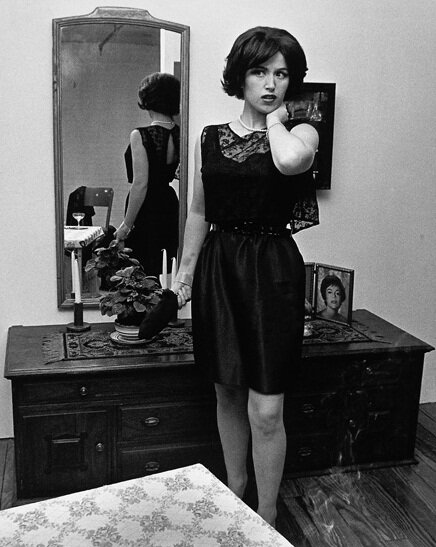
The fashion and illustration work in an odd sort of way reminds me of Cindy Sherman... True, she was not the auteur of these images, McGinnis was... but Hite was something close to a collaborator in that body of work... as she was with the pictures above, and below, done with the German photographer Iris Broch.
The photographs of Hite, and the book covers based on her image, are like the material, the archive of archetypes and poses, that Sherman recreates for her work.
"Others might try to break open that web of mirrors, but Sherman's way of revealing it is just to keep on skilfully turning the kaleidoscope where a few fragments of fantasy go a long way"
- Judith Williamson, Images of 'Woman', 1983
Actually, thinking about it, Hite's sense of style (behind the times, expensive, vaguely patrician) was not unlike the more or less contemporaneous women known as theSwans - the coterie of upper class society women that Truman Capote mingled with and then cruelly satirised in Answered Prayers. As dramatized in the recent Feud: Capote vs. The Swans.
Second only to the Republican Christian women who sabotaged the Equal Rights Amendments, the Swans were the high-profile anti-feminists of the era - trophy wives whose entire lives were dedicated to conspicuous consumption, socializing and society events, gossip, pecking-order disputes.... and affairs. These were often accomplished and brilliant women, but their abilities were penned entirely within the domain of appearance - their own physical appearance, which was immaculate and expensively achieved, but also social appearance: maintaining the facade of a perfect life. (Okay, there was a bit of noblesse oblige philanthropy and that kind of thing - as much done for show as for altruism). There was a rigid and total specialization of roles within the marriage: the wives handled all the inessentials that make life pleasant, while the husbands got on with the business of running the world.