successor to Shock and Awe whose feed no longer seems to be working properly - original blog + archive remains here: http://shockandawesimonreynolds.blogspot.com/ ^^^^^^^^^^^^^^^^ the blog of the Simon Reynolds book about glam and artpop of the 1970s and its aftershocks and reflections to this day
I thought I had heard everything - but the munificence of all the vintage Top of the Pops episodes on YouTube supplied surprise
Here, in 1977, savagely behind the times, a group I never even heard of: a late glam / artpop outfit called Contempt.
I suspect the influence palette includes Queen, Sparks, Roxy, possibly 10cc, possibly Cockney Rebel, possibly Bebop Deluxe, maybe even Sailor
Cynical and snooty wordliness meets a clean frilly guitar sound and a dapper and genteel non-rock image.... and a bit of pomo too (the song is essentially "Money Makes The World Go Around" from Cabaret merged with"Diamonds Are A Girl's Best Friend"
"Never even heard of" .... that might be because they only ever released a single single
Here's a funny thing, though - look closely, and this was produced by Martin Rushent. At roughly the same time he would have been producing The Stranglers and then a little later, Buzzcocks and 999.
The name of the productions company is funny: Atit.
As in "at it". Or "a tit".
Hauteur Theory #2: Declensions of Duncan
Another late-glam group with a snooty sophisticate image.... like Contempt, caught out by New Wave, and rendered therefore untimely: Metro, whose core was Peter Godwin and Duncan Browne.
I think these adverts were printed in this sequence, teased out over three weeks....
Or maybe it was within a single issue, on successive pages.
Top of the Fops!
Metro described their sound as “English rock music, but influenced by a hundred years of European culture… Baudelaire and Kurt Weill”
One of their songs was later covered by David Bowie - "Criminal World" (on Let's Dance)
You never told me of your other faces
You were the widow of the wildcat
And now I know about your special kisses
And I know you know where that's at
I'm not the queen so there's no need to bow
I think I see beneath your make-up
I'll take your dress and we can truck on out
This is no ordinary, this is no ordinary
Oh, what a criminal world
The boys are like baby-faced girls
What a criminal girl
She'll show you where to shoot your gun
What a typical mother's son
The only thing that she enjoys
Is a criminal world
Where the girls are like baby-faced boys
You've got a very heavy reputation
But no-one knows about your low-life
I know a way to find a situation
And hold a candle to your high-life disguise
I saw you kneeling at my brother's door
That was no ordinary stick-up
I'm well aware just what you're looking for
I am no ordinary, I am no ordinary
Oh, what a criminal world
The boys are like baby-faced girls
What a criminal girl
She'll show you where to shoot your gun
What a typical mother's son
The only thing that she enjoys
Is a criminal world
Where the girls are like baby-faced boys
Ooh look, a year before Bowie, Hot Gossip covered it
Duncan Browne was one of those figures who just cropped up again and again, slightly style-adjusted, in different phases of the rock dialectic
Donovan-ish in the Sixties
(lovely song I think)
Pioneering rock critic Richard Goldstein described this album as "Pre-Raphaelite Rock"
Then folk-tinged singer-songwriter (Murray Head on the moors)
His one hit, produced by Mickie Most (former Donovan producer turned glamglitterpop producer)
Then glammy-aristo in the Seventies, with Metro
Lotta nostril energy in this band portrait
Then there's a later phase where it's yacht rock, more or less.... or in alignment with post-reformation Roxy slickness / Bryan Ferry solo
This cover is like a Roxy Music cover combined with an early Bryan Ferry solo album cover
I do enjoy this thing where artists keep moving with the times, adjusting their basic thing according to the new style - whether through desperation to finally score a hit, or simply their taste changing in alignment with everybody else.
And why not? Fans do it, critics do it too.
Still Duncan B had the integrity* at least not to go "New Wave" - he couldn't move that far from his basic debonair mode.
Unlike Bryan Ferry (but like Kevin Ayers), Browne was the genuine poshboy-in-pop article:
Duncan Browne was born on March 25, 1947. The only child of Air Commodore and Mrs. C.D.A. Browne, Duncan initially intended to follow his father into the Royal Air Force. He was turned down on health grounds while still at the Workshop College, where he was a promising schoolboy actor and clarinetist.
A classical guitarist, he attended the London Academy of Music and Dramatic Art for three years, where he studied Composition and Harmony with the legendary Anthony Bowles, who encouraged him towards a career in music
* (Actually Metro did go "New Wave" but without Browne's involvement)
* Actually I am wrong here - Metro, with Browne involved still, did a very short-lived alter-ego as Public Zone, with Stewart Copeland on drums, and it's totally New Wave.
"New York Dolls go to Studio 54" is how I describe them in S+A
A parallel noticed at the time
And then of course the names - Sylvian / Sylvain, Jansen / Johansen - are the giveaway
Looking and listening to "Adolescent Sex" again, it's like the sound and the look of the song / promo is entirely sourced in the guitar break in "Amazona"
But the other thing about the image is that it is hair metal a decade too soon
I don't understand why "Adolescent Sex" didn't do a "Welcome To the Jungle" and instantly propel Japan to Guns N' Roses level
(Not that I would want to have foregone their growing-up so exquisitely)
In this publicity photo from 1977 theylook like they belong on the Sunset Strip in 1987
Actually what they look like is Def Leppard.
Or Hanoi Rocks.
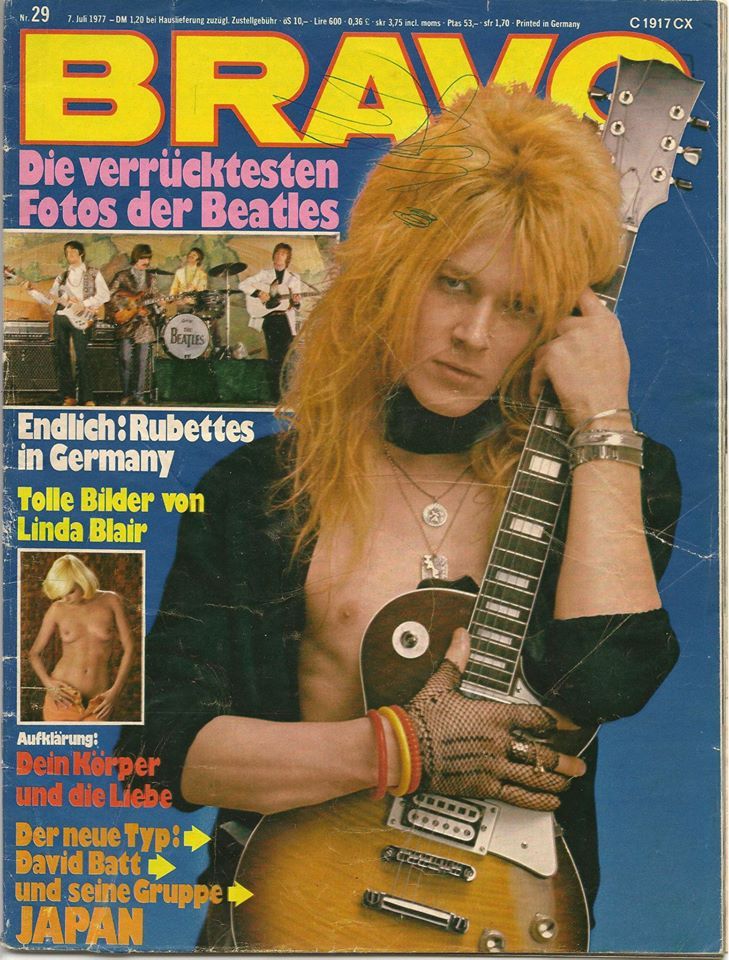
Another 1977 image is totally hair metal - and again, like a premonition of Axl Rose, from the reddish blonde hair to the ice cream face and the hairless chest
Ooh, how funny - they identify him on the cover by his real name David Batt, not David Sylvian
How the single was pitched to the public
Two different crotches - same hand, though!
Or maybe it's the same crotch, different trousers?
Supposedly they had an ad - or maybe it was A stage projected image - around this time, of David Sylvian, bare-chested but with female breasts.
Sometimes I'm not sure if I came across that in my researches or just dreamed it!
Hmmm, maybe it's something I heard when I interviewed Simon Napier-Bell, who managed them.
Re. the discorock feel of the tune, they were actually signed to Ariola-Hansa, a disco label
Oh! you pretty thing!
Sylvian, of course, very embarrassed by this debut album and whole first look-sound
This era doesn't have quite enough killer tunes though - nothing that would inspire you to dream up a whole counterfactual universe where Japan invented pretty-metal, make-up metal, glam metal, peroxide and blow-dry metal, a decade ahead of the game, like "Adolescent Sex" does
Such poseurs
(I know it's not an official video, but a fan creation using this)
Addendum: below a couple of ancient Blissblog posts about David Sylvian and Japan, in response to this K-punk celebration of the groop circa Tin Drum, titled "The Barthes of Parties"! "Adolescent Sex" pops up towards the end...
The escape artist.
Mark’s mini-essay on Japan is so immaculate and exquisite, it seems almost churlish to say that, actually, I find “Ghosts” rather a moving song. I’m not alone either--there’s the missus (possibly America’s #1 Japan fan-- a lonely breed), and there's Goldie (he sampled it on Rufige Cru’s neglected classic “Ghosts of My Life”, a masterpiece of svelte darkcore), and Tricky ("Aftermath" has a sample from "Ghosts", right, or a lyric-quote?), and maybe even Dizzee Rascal (judging by the the Sylvian-Sakomoto vibe on ‘Sittin’ here’ and “Do It”, the two melancholy songs that bookend Boy In Da Corner).
Carrying on previous trains of thought, I suppose my question is: would it actually diminish the song to believe it had some source or emotional referent in David Sylvian’s real life? To take it as both haunting and haunted. He’s very stylized as singers go but it seems like “beautiful sadness” is something that runs through a lot of his work (along with the quest for serenity) and you could see him as having less to do with a mannequin like Steve Strange and more with Scott Walker, or Nick Drake, or even Frank Sinatra (melancholy given poise, pain contained through elegance). Or Ian Curtis--“Ghosts” in some ways seems like a sister song to “Love Will Tear Us Apart”.
Whenever I see someone who has pulled off a really drastic form of self-reinvention, gone all the way with artifice and masquerade--be it Strange, Numan, Leigh Bowery, Marilyn Manson--I always wonder: what are they running away from? It takes so much energy to do that and to maintain it. (I can barely muster the strength to look halfway presentable to the world).
With Sylvian, perhaps the word “Catford” is explanation enough. No slight to that town but if it’s like 95 percent of the UK or anywhere else for that matter, then you can imagine why the sparkle-starved, culture-famished David would want to dedicate his life to exquisiteness, alien glamour, forbidden colours, to turn himself into a perfect surface, to get away and never go back. But there’s something more, I suspect: thinking of him performing "Ghosts" on TOTP, the excessive poise and stillness, the statuesque quality of his vocals (a frieze of emotion, almost), the perfectly made-up blank white expressionless facade, to me it all screams internal struggle, damage in the depths. Real ghosts in his real life.
“Lines of flight” always carry with them traces of what’s left behind. Can we even conceive of escape or reinvention of the self without registering what's being escaped from, or acknowledging the raw, base matter that is remoulded into a human art object?
I think you could work up another reading of Sylvian, not opposed but supplementary to Mark’s.
It might cue off Penman’s riff about class and Bryan Ferry’s voice, how its alien-ness was produced by the struggle of a Geordie trying to sound debonair --and how that slightly grotesque quality disappeared when he perfected the po(i)se and shed the last traces of Tyneside. (Joy says one of her Japan fan acquaintances had managed to find a very early radio interview with Sylvian where he's talking with a thick Catford accent--again the struggle, the effort that goes into changing one's voice).
It might then proceed to examine Bowie/Roxy and the glam end of artrock, its motor fantasy of stepping outside the lowly world of production into a sovereign realm of pure unfettered expression and sensuous indulgence, an imaginary and fictitious notion of aristocracy (more Huysmans than real lords who have to do humdrum things like manage their estates, juggle their investments, do a bit of arms dealing). It might pause to consider briefly the disillusionment of actually achieving the supermonied aristo life--Ferry, condemned to mooch jaded forever through art openings, fashion shows, all tomorrow’s parties (that old tis better to journey than arrive line).
It might also look at the history of Orientalism and its relationship with dandyism. The Far East and its codes of etiquette, the extreme stylization of emotion in its art; grace and symmetry. (Didn’t Barthes write a whole book about Japan--the country, not the group!--called something like Empire of Signs, one of its ideas being Japanese culture as a realm of surfaces, where the depth model is abolished--he had this idea that the Japanese don’t think eyes are windows to the soul, they see them as attractive but flat planes).
There must be some connection between artrock’s ruling-class fantasies and ideas of China or Japan as extremely well ordered, disciplined, hierarchical societies. There’s a bit of totalitarianism chic going on--Mao, the Emperor, Mishima etc--that parallels Bowie’s “what this country needs is a really strong leader” flirting with fascism phase, or Iggy with his “visions of swastikas” and plans for world domination (and those are lyrics from “”China Girl” come to think of it). As reheated by the New Romantics: Spandau Ballet’s Journeys To Glory with its noble torso statuary on the cover and Robert Elms’s faintly fascistic sleevenote, the whole idea of a Club for Heroes.
Glam's tendency (through its shifting of emphasis toward the visual rather than sonic, spectacle rather than the swarm-logic of noise and crowds) towards the Classical as opposed to Romantic. Glam as anti-Dionysian. The Dionysian being essentially democratic, vulgar, levelling, abolishing rank; about creating crowds, turbulence, a rude commotion, a rowdy communion. Glam being about monumentalism, turning yourself into a statue, a stone idol.
bit more on Sylvian...
“Ghosts” is one of only two things by Sylvian I paid money for, so maybe Mark is right about it being exceptional in the Japan canon for its overt emotion; other stuff, like “Art of Parties”, sounds great but was a bit disengaged for me. But per Mark’s reading, maybe that’s what great about it, the slink of the surfaces.
The other thing was “Bamboo Music/Bamboo Houses” by Sylvian-Sakomoto: amazing drumming
The China/Japan totalitarian chic thing doesn’t run deep, sure… it’s appropriately shallow, flirtation with decontextualized signifiers in true glam style. Still I notice that there’s a song called ‘Communist China’ on the first album, while on the Teutonic tip there’s “Suburban Berlin” and “Nightporter” which I assume is inspired by the Dirk Bogarde as Nazi-in-hiding movie. They also have a tune called “.... Rhodesia” bizarrely enough---surely the only rock song about this white-power pariah of the world community state, although I daresay there's a roots reggae tune of the same title.
That bio Mark links doesn’t mention “class”’ as such (maybe press releases should come with sociological data). But I’d hazard a guess re Sylvian: he’s from that upper W/C, lower M/C indeterminate greyzone whence so much great UK pop stems.
The later stuff’s not as barren as Mark makes out (although I once dismissed Sylvian solo as “jet-set mysticism”, while Jonh Wilde’s description of his voice as sounding like hair lacquer struck me as uncomfortably apt). But the “Gone To Earth” instrumentals are lovely in a Durutti/Budd/John Abercrombie sort of way, while things like “Orpheus” and “Waiting For the Agony To Stop” have a certain Scott Walker-goes-ECM grandeur.
But I would swap his entire solo career for “Adolescent Sex” the title track of the first Japan album. It’s like disco-metal or something, its sashaying glitterball raunch and cokane dazzle suggesting a whole lost future or parallel pop universe. It’s like Guns N’Roses “Welcome To the Jungle” produced by Daft Punk circa “Digital Love” or something. This totally plasticized, artificial rock music that still rocks. (The only thing I’ve heard like it is some tracks made by Last Few Days, a second-tier industrial group who circa ’89 totally reinvented themselves as this glammed avant-raunch outfit and got a major label deal. Then they unwisely went house and that was that).
It’s interesting how Japan (and Foxx-era Ultravox too come to think of it) had so many of the same inputs and reference points as Siouxsie & the Banshees---Roxy, Velvets (Japan covered ‘All Tomorrow’s Parties’), Dolls, Eno, Bowie, similar movies and books too I’ll bet, similar flirtations (that decadence/fascism/S&M/voyeurism) and shtick (ice queen, don’t touch me, regal remoteness, I am a machine, metal will rule in my master scheme).
And yet the Banshees were deemed "punk" and all through this period Japan and Ultravox were jeered at as glam johnny-come-latelys, throwbacks. If you reconfigured glam as the true 70s revolution/upheaval in 70s UK pop, and made punk into its aftershock, you might get some interesting results.
Mark quotes Penman on the later Ferry stranded in an “autumn swirl of shriveled or dying signs (that once were lustrous: 'dance' - 'drug' - 'love'), making solemn play of an immensely empty escape in the facades of an eternal tone - windswept, misty, limpidly sensual, banal.”
The comeback Roxy is something I’d probably have mostly disregarded at the time, except in an idle radio enjoyment way--not sure I’d even heard the original Roxy then, so had no disappointment or betrayal to bring to the table. But I always really liked the glint-swirl synths of “Same Old Scene” and in retrospect this wanly elegant later Roxy/Ferry--“More Than This”, “Avalon” --has a certain narcotic allure. Weirdly, it’s like Ferry’s arrived at his own wispy aristocratic version of ambient music.