Showing posts with label ARISTOCRACY. Show all posts

Monday, July 14, 2025

In The R.Elms of the Senseless (the style press then and now)


NME cartoon circa 1981 nicely skewers the self-declared aristocracies of club culture 


Apropos


Oh the myopic narcissism of the young!  Or in this case, the once-young....  

Of course there was rather a lot more to the Eighties even within the narrow realm of trendy clothes worn and trendy sounds danced to than what went down at Blitz

A preponderance of  right-time-right-places... and we won't even get on to rock's claims on all that

I'm sure it's just a subtitle to sell books and he doesn't actually believe that Blitz set the template for the entire decade.

Would be tragic if he did... 


In The R.Elms of the Senseless....  Actually I don't mind his Face-era writing at all -  a naturally gifted rhetorician, in full command of those cadences that announce "listen up, I'm about to hip you to the score", carrying you along despite yourself. 

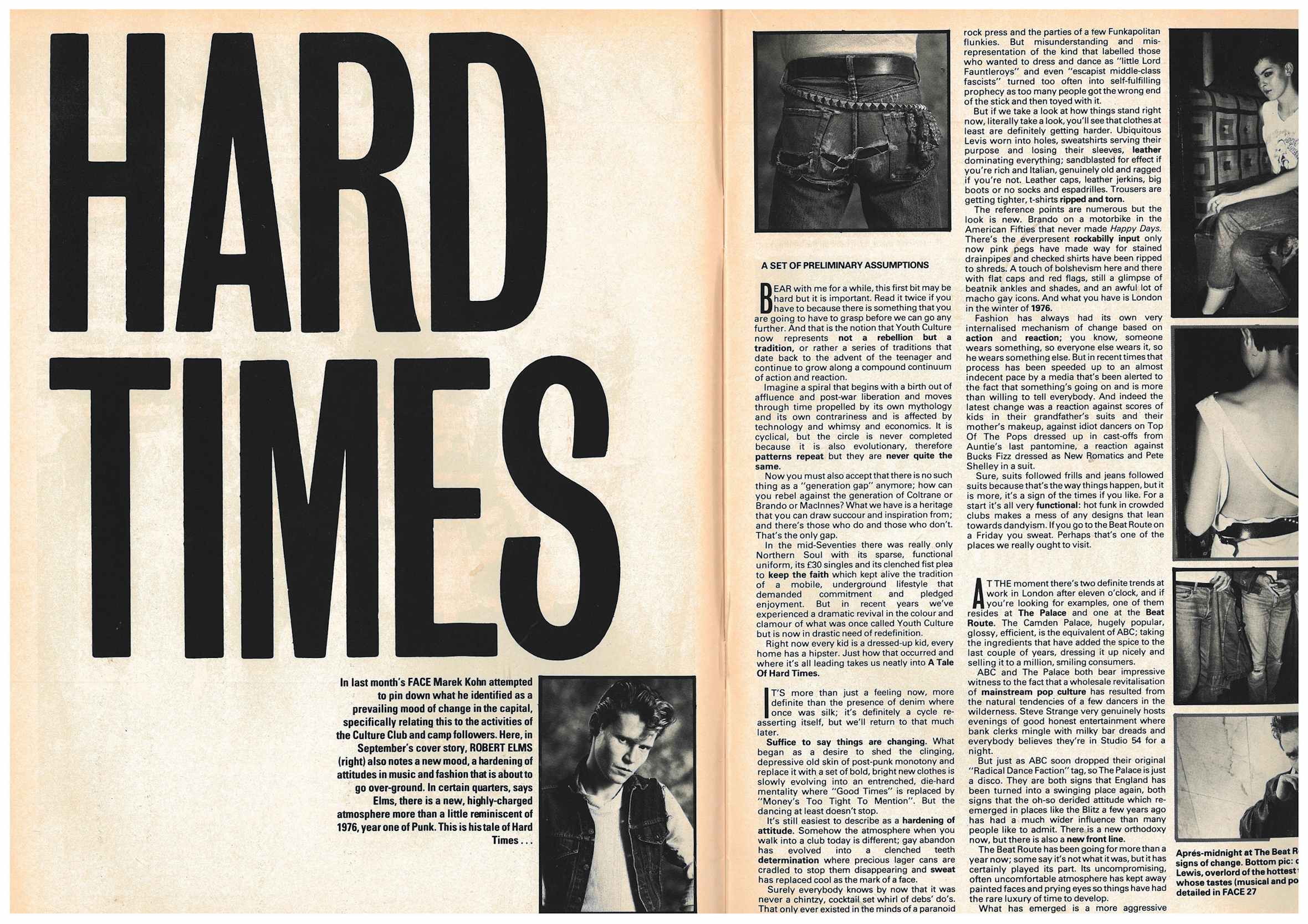
The Hard Times piece, while risible in its complete reversal on Blitz-escapism, is a rhythmically exciting read - redeemed (or at least, made effective) by the sense that he really does believe it, in the moment of typing. 


Then there was another turn of the cycle - Hard Times (clubbing as political, deejays as militants, torn jeans as recession wear. "Money's Too Tight To Mention") was followed a few years later by Good Times (not quite an overt celebration of casuals and their expensive sweaters but it does say "money is in")


NME cartoon from 1983 skewers the Hard Times concept


The concept of "Style" discussed on the Oxford Road Show by Elms, Annie Clayson and Peter York (who opines that "Money is stylish") 


Talking about self-declared aristocracies 

“Picture angular glimpses of sharp youth cutting strident shapes through the curling grey of 3 am. Hear the soaring joy of immaculate rhythms, the sublime glow of music for heroes driving straight to the heart of the dance. Follow the stirring vision and rousing sound on the path towards journeys to glory.”


That's Robert hymning Spandau on the back cover of Journeys To Glory 


Prototype draft for the Journeys to Glory notes (via the Blitz exhibition at Design Centre)


The 1980 NME live review (no worries about conflict of interest in them days! he'd only named the band.... ) that launched it all


"Their strident elitism means that unless your ears are pinned firmly to the 'right' ground your chances of seeing them are at present slim. On the evidence of their latest performance it really is your loss"


The stringent obsession with absolutely correctness - the minutiae of distinction


Love this idea that Bowie copied them, the boys from Burnt Oak!


NME pisstake Elms's I-wanna-Face-of-me-own venture New Sounds, New Styles


A novelist, yet... Wilde gives him a hard time, boom boom

^^^^^^^^^^^^^^^^^^^


In the Eighties, I used to think of the style bibles as the enemy but I read them avidly - well they had loads of good writing, including a lot of people who once used to write for NME and the other weeklies. The Face had some of the sharpest columnists around - Savage, Burchill, Marek Kohn.... and the super intellectual team of Steve Beard and Jim McClellan, who seemed to oscillate between The Face and iD.

And in truth I would have been happy to write for them and in fact did write for iD, sporadically in the second half of the Eighties, and then after a pause, again a few times in the '90s.   (Eventually I did write for The Face too - in the 21st Century). (Oh yes and well before that, in the early 90s, I did some stuff for Arena - which was a sort of men's magazine offshoot of The Face, yet another Nick Logan invention with Neville Brody design). 

In the 1980s, the style bibles were useful adversaries, ideologically speaking. They beamed out this fantasy of metropolitan chic and rock-is-dead eclecticism - the idea that there's a place where it's all happening, an in-crowd subworld - they beamed this dream out to hair salon owners and aspiring fashion designers in the sticks. 

We at MM pushed our own quite different fantasies. 

The thing that surprised me when I went around to the iD office, which was then quite near Melody Maker, Drury Lane / Holborn, is just how shabby and cramped it was. Melody Maker was incredibly messy but it was quite a large space.  And quite bustling. The iD office was empty apart from the editor Dylan Jones and assistant editor Alix Sharkey, whose face I recognised from fronting the Morley-hyped but spectacularly null funk outfit Stimulin.


                                                iD staff plus Chris Sullivan of Blue Rondo A La Turk plus Robert Elms                                                    plus Peter York all have cameos in this bizarre Arena film about Eighties  ligging at different strata of society

And apparently it was much the same with the Face in its first decade or so - a shoestring operation. Not the chic salon-like place that the design and the look of the magazine would suggest. 

Both magazines were done on a meagre budget yet managed to concoct this mirage of hip London that they transmitted all across the country and indeed internationally. (Joy bought both religiously).

If you look at an old issue now, especially early on, you can see how Face and iD were cobbled together in a last-minute dash just like the music papers. All kind of no-hope chancers getting featurettes, completely forgotten groups and motormouth types hawking something or other.

I remember Kodwo Eshun - I had no idea then who he was going to become! - came up to interview me (supposedly for the Oxford student mag Cherwell - I think he just wanted to meet). During a lively conversation at an outdoor table in Endell Street, he expressed disappointment that we hadn't gone straight from Monitor to The Face and iD. Like it hurt him to have to pick up a copy of Melody Maker every week, this broadsheet that left ink on your fingers.  

But I rather liked the idea of operating from this supposedly clapped-out, obsolesced institution, going against the grain of times.  (When the grain of the times was things like Absolute Beginners). 

Besides, the format was in alignment with what we were pushing - a resurgent rock underground.

Also the music papers came out 51 times a year, whereas the style mags came out monthly. So there was just vastly more space for our verbosity to frolic in. 

I should imagine it was very hard for a freelancer writing for a style magazine to make enough to live on, given you only have 12 paydays a year. And I seem to remember the iD word rate was modest, no better and possibly worse than the frightful word-rate at MM.  At MM, if you were prolific and voluble, you could make a nice living as a freelancer, simply because there was so much space to fill. 

The 51 issues (Xmas a double, lasted a fortnight) enabled you to construct more of an ongoing world.

That's what all these magazines were about - world creation, world maintenance. 

I miss that. Is there any publication today, print or online that does that?

Well, No Bells does. They have meet-ups, events where people read music criticism aloud. It's a social space, not just a disembodied discourse space. The magazine is a locus of vibe. 

Talking of style bibles, on a recent trip to New York, we went into a store that was choc-a-block with magazines into cutting edge fashion. Sort of modern day equivalents to iD and Face (both of those still going of course, as print entities - and bigger than ever in a literal sense - each issue is a monstrous paving stone of glossy fashion spreads, adverts, something you could injure yourself with if you picked it up without bending your knees properly, or injure someone else with, if wielded as weapon.) 


I was staggered by how many of these style magazines there were - piled up everywhere, not an inch of space in this hipster newsagent I guess. From all over the world, with Steve McQueen-esque ugly-as-beauty images on the front. 


Rather like with art books, I wondered what the financial and production logistics are when doing a magazine like this  - quality paper stock, full gloss ultra-vivid images.  The bottom line. 

Do all the photographers and models and make-up and styling people just work for free in the hope of furthering their careers? 

Advertising must bring in some money, from fashion and beauty products and trendy shit. But the cost of doing something so luxurious looking and feeling, and in presumably quite small print runs, must be enormous. And then the physical cost of distributing something so bulky. The shops must take a hefty mark-up given the amount of sheer volume each issue takes up.


Also rather like with art books, I wondered who actually buys these things,... They seemed to be retailing anywhere from $20 to $40 bucks each.  I have a mental block with paying that for a magazine. 


So I guess very rich people, or cutting edge fashion obsessives (same difference?).

And they doubtless function less as something to actually read and more like a coffee table book. Something to flick through desultorily or just have sitting there. 


Still mystified by the title of this sports-as-style-microculture magazine


^^^^^^^^^^^^^^^^^^^^^^^

Paul Oldfield fires a salvo at The Face on the occasion of its 100th isssue.

And also analyses Neville Brody's work.


^^^^^^^^^^^^^^^^^^^^^^^^


Wandering around NYC I was amazed how saturated everywhere was with fashion advertising. I mean, yes it's always been there, but it was really kind of total in places like SoHo. Enormous, glossy images. Everything hyper-real and supersaturated. Often on LED screens rather than just posters. 

Was also startled by the fashionization of Dr. Martens


I remember in the 1980s having to going to a rather poky, plain shop next to Camden tube station to get DMs.  The kind of place that would do shoe repairs and cut keys as well as sell shoes. (Actually I might be imagining that aspect but it certainly had nothing fashion boutiquey about it). 

DMs were "cool" through the skin and punk connection, but they still had some kind of residual currency as practical footwear, the kind of thing someone who worked in a factory or on a building site might wear for protection against things falling on the foot. 

I expect this chic-ification has been going on for a while and I hadn't noticed. 

Our kid asked for a pair of DMs some years ago and only wore them once - I was furious. They cost about $130. 


^^^^^^^^^^^^^^^^^

"the treacherous Elms"


The Way We Bore


Carlyle had this type figured a century plus earlier

"First, touching Dandies, let us consider, with some scientific strictness, what a Dandy specially is. A Dandy is a Clothes-wearing Man, a Man whose trade, office, and existence consists in the wearing of Clothes. Every faculty of his soul, spirit, purse, and person is heroically consecrated to this one object, the wearing of Clothes wisely and well: so that as others dress to live, he lives to dress. The all-importance of Clothes, which a German Professor, of unequalled learning and acumen, writes his enormous Volume to demonstrate, has sprung up in the intellect of the Dandy without effort, like an instinct of genius; he is inspired with Cloth, a Poet of Cloth. What Teufelsdröckh would call a 'Divine Idea of Cloth' is born with him; and this, like other such Ideas, will express itself outwardly, or wring his heart asunder with unutterable throes."


^^^^^^^^^^^^^^^^^^^^^^^^^^^

R.Elms makes a cameo in this report on Marxism Today's 1986 conference on the Left's problem with style and hedonism for its own sake


Tuesday, May 20, 2025

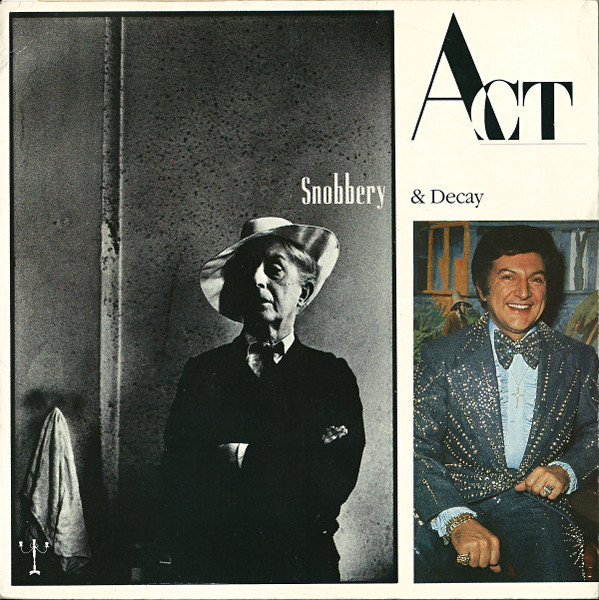
pro-theatricality in pop (Act present Showtime)


Me on Act and ZTT in New Statesman


The full epic version


"The song is taken from the Leer-BrĂĽcken musical 'Name Dropping (songs from beyond the me-decade)'"


"This is the age of entertaining"


Minelli-laced version


The Naked Civil mix hahaha 

(Quentin on being cold and splendid - crisp to the eye)


Champagne dreams, caviar wishes

And watch them grow from rags to riches

Money to burn, money to give away


Lifestyles of the rich and famous

And look and them who can blame us

Lessons in the subject of decay


Come tomorrow, the dream might blow away

Guilt and sorrow, the price you have to pay


Snobbery and decay

Snobbery and decay


You’ve got yours, I’ve got mine

Obsession, just like Calvin Klein


Fantasy, ecstasy, designer dream, obscenity


Snobbery and decay

Snobbery and decay


Nothing to do, nothing to pay

Nothing but snobbery and decay


Land of the free

How can you tell?

The bigger they come the harder they sell


Here’s to you

Here’s to me

A future aristocracy


Property, poverty

An unstable economy


And decay

And decay


Snobbery and decay

Snobbery and decay


I am the repertoire

Snobbery and decay


The CD single version - nice visual pun there


The album Laughter, Tears and Rage wasn't on a par with the single, sadly.


Funny...


Leer at his best - six years earlier


So many "Snobbery" mixes


A mix for Stephanie Beacham (as in Dynasty)


"Strong Poison", even


Now this is glamorous


Fassbinder-fanboy directing?


"Duel" / "Jewel" the only time Propaganda really swayed me


A beautiful melody, written to suit Claudia's voice, no strain, and the product is, well, cut-glass


"Duel / Jewel" run on as on the album A Secret Wish


Cut Rough / Rough Cut - is there a difference?


The other one was originally meant to be the singer but Trevor Horn insisted Claudia do it as the other one was not up to the job


Eye to eye, stand winners and losers
Hurt by envy, cut by greed
Face to face with their own disillusion
The scars of old romances still on their cheeks
And when blow by blow
The passion dies sweet little death
Just have been lies, some memories of gone by time
Would still recall the lies
The first cut won't hurt at all
The second only makes you wonder
The third will have you on your knees
You start bleeding I start screaming
It's too late the decision is made by fate
Time to prove what forever should last
Whose feelings are so true as to stand the test?
Whose demands are so strong as to parry all attempts?
And when blow by blow
The passion dies sweet little death
Just have been lies, some memories of gone by time
Would still recall the lies
The first cut won't hurt at all
The second only makes you wonder
The third will have you on your knees
You start bleeding I start screaming


S+M bondage Skin 2 fetish wear and all sortsa kink were kind of hip in the early 80s...  that sort of pomo postfeminist moment


The glassy yet brutal sound and crashy drums seems to anticipate Jam City Classical Curves and SOPHIE "Faceshopping"

Glitter shards to cut your face to ribbons 

Classical Curves was “a record about being repulsed and fascinated by the glossy surfaces of a certain 'high-end', hyper-capitalist consumer society” 

e.g. “Her” with its robo chant and sounds like a battery of camera flashes  "Work work work flash / Work work camera flash work / Work camera flash / Work work work flash". Poses being struck as blows struck to the eye...

Obliquely inspired by ballroom and vogueing I should imagine


Back to Propaganda...

Mr BrĂĽcken has a go at remixing


I should imagine it was Morley's idea to cover Josef K's "Sorry for Laughing", direct some money towards one of his favorite writers, Paul Haig


The Unapologetic Mix, haha


Everyone involved should apologize for that version 


A live version


Later career is the definition of Wiki Fizzle (trust me, don't look)

but...

I was oh so prepared for this to be terrible but it's actually rather good 


Claudia's got good taste - this is my favorite song by The Band and it's quite a sensitive treatment

The Band are about as anti-glam as it gets it, funnily enough.

Monday, April 1, 2024

"aristocratic glam"

Mark Fisher would say that glam is intrinsically aristocratic. 

But it's supposed to be a Tom Ripley type interloper - someone from the lower echelons of society who sneaks his way in. Borrows the clothes and apes the manners of the nobs. Artfully, cunningly, through unstinting attention to detail, becomes "one of them".  

As if to the manor born - but actually an upstart of lowly birth. A parvenu. 

Glam as aesthetic class war. Usurpation in the realm of symbols and representation. 

Although the wealth and fame thereby won can enable a literal form of infiltration. 

Bryan Ferry as pit-worker's son who first imitates - and then penetrates - impregnates... the actual upper classes. Marries into blue blood...  breeds some Eton-bound hunting 'n' fishing brats... hangs out with Dukes and discusses vintage wines. 

Or - fictionally - the narrative arc of that silly film Saltburn

What would Mark say, then, about an actual blue-blood doing glam?  

Hark at this for a pedigree! 

Daphne Guinness - socialite / fashion model / fashion writer / curator / film maker / actress turned pop singer.

Scion of the Guinness dynasty and the Mitford line. 

Her grandmother was Diana Mitford, who divorced Guinness and married Sir Oswald Mosley, leader of the British Union of Fascists.

Daphne grew up moving between country houses owned by her family in England and Ireland and a villa in Spain. Salvador Dali was a family friend. Later lived in New York (where her sister worked as a PA to Andy Warhol).

Muse to fashion designers Alexander McQueen and Karl Lagerfield. Friend to Isabella Blow

Has her own Comme des Garcons scent, named Daphne

Encouraged by David Bowie to purse music. As a result... 

Produced by Tony Visconti

Claimed to known nothing about her step-grandfather's politics when Mosley's death announced. 

And yet here is a song named after hierarchy-obsessed Emperor-admirer Mishima!


"Named after the renowned Japanese poet Yukio Mishima, who Daphne was introduced to by a Japanese nanny she had when she was between the ages of three and five. Her name was Etsuko, she recalls, and when I was three and Mishima died, my father found me on the back staircase trying to commit seppuku. I said to him, 'I think I'm Mishima.’ The track also features traditional Japanese instrument, the shamisen. I bought it when I was in Japan with my friend Nori. He took me to this man who was about 85 and still making shamisens and they couldn't believe that I wanted it."

Introduced by her nanny


New single


A bit "Warm Leatherette", a bit Deborah Evans-Strickland from Flying Lizards, a bit Marianne Faithfull

"I might look like an icicle, but underneath I'm a volcano"


This triptych is - sonically - a bit sub-White Noise / Julie Driscoll / Broadcast 


I've heard.... more wieldy voices, let's say. 

Discography includes Optimist in Black (2016), Daphne & the Golden Chord (2018) and Revelations (2020), the contents described variously as "drama-pop with a gothic tinge",  "glam-rock-ish," and "aristocratic glam fuelled by wit, character and a clear and abiding love of rock'n'roll".


"I'm a rather private person - and armor to me is many sorts of masks... Japanese Noh theatre... make-up... you become a different persona"

It's a bit Glam 101.

"I like haute couture because it's the last vestige of something that's been an integral part of Western Civilization from very early on"

Last-vestige-ism = a bit of a political giveaway. 

Relates perhaps to my idea of fame as a secular version of royalty / royalism. 

At the top I wondered what would Mark Fisher think of a member of the actual ruling class becoming "glam". 

To me, it would seem to be... not much of a journey, more a case arriving back where you started, or confirming what you already are. 

So the opposite of the pop idea of self-reinvention. 


Concentration of wealth addendum: 

"In 1987, she married Spyros Niarchos, the second son of Stavros Niarchos... Her $39 million settlement, obtained at the time of her 1999 divorce, was added to her Guinness inheritance."

More recently partnered with philosopher and public intellectual Bernard Henri-LĂ©vy, whose own inherited fortune had grown by 2004 to be in the vicinity of 150 million Euros - probably more now unless he's a complete bumbler. 

What does it say in the Bible? 

'For to everyone who has, more will be given, and he will have abundance; but from him who does not have, even what he has will be taken away.


Sunday, August 27, 2023

A kestrel for a knave, a merlin for m' lady


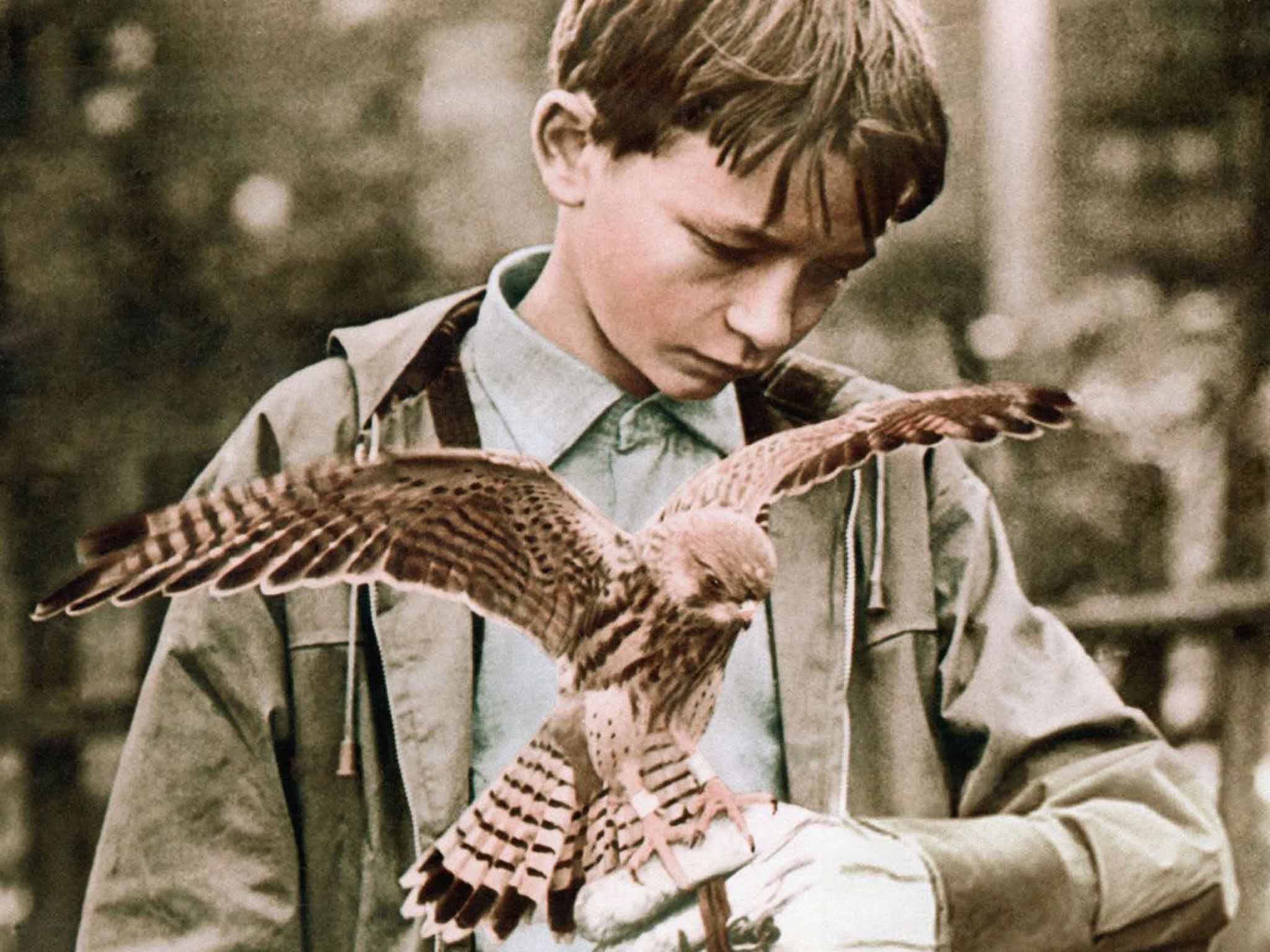
Kes is a film that made a big impression on me as a child. If I recall right, it was in a double bill with the rereleased Fantazia - at any rate, I saw it first on the big screen at our local cinema The Rex, with my mum, and then many times after that on the television. 

In my memory, I think of it as a black and white film (well, we did have a black and white TV for the entire '70s) and so it's always startling to see that it's actually colour. 

But the black-and-white mind's eye misremembering fits the grey, grim world of the Yorkshire mining town in which the boy Billy lives - and the monochrome movie genre to which Ken Loach's film belongs (Billy Liar, A Taste of Honey, Saturday Night and Sunday Morning, The Loneliness of the Long Distance Runner etc).. 

Looking into the story of the the film and of Barry Hines - who wrote the original novel and co-wrote the screenplay - I suddenly thought of another Northern lad with a thing for falcons: Bryan Ferry


The  model on the cover of Avalon is Lucy Helmore - who was a model but was also Ferry's posh young bride. But for the very first time in that long line of lovely ladies on Roxy covers, you can't see her face - that's Bryan's private  privilege.  

Indeed, c.f. the states of undress in which the Roxy girls hitherto have been exposed to the camera, Helsmore's body is encased protectively (chain-mail?). Not an inch of skin is visible -  her hand is covered entirely by a falconer's leather glove.

"The Avalon album cover was shot at dawn, on a lake at Helmore’s parents’ house in Ireland, with Helmore wearing a medieval helmet and carrying a falcon – designed to evoke King Arthur’s journey to Avalon, his final resting place and the mythical land where his sword, Excalibur, was forged" - Jason Draper

And here's his nibs himself, in the "Avalon" promo, brandishing a bird of prey. 


Filmed at Mentmore Towers country house


But what's the Kes connection? What bridges the gulf between Hines + Loach's Northern social realism and the aristocratic fantazia of Roxy Music? 

Well, those aristocratic fantasies stem from BF's reaction against his background - his dad was a farm worker who then toiled at a coal mine tending the pit ponies and descending with them into the Stygian depths beneath County Durham.

And in Kes, young Billy is soon to leave school aged 15 - although he looks about 12, small and scrawny and half-starved. One scene involves a meeting with the school's employment counsellor, who makes it clear that that the only real option facing someone without qualifications like Billy is the coal face - working in the same mine as his older brother Jud. 

Billy is adamant he won't work in the mine. (Bryan F has said that the best advice his dad ever gave him was: "Don't go down the pits, lad"). Hines himself was the son and grandson of coal miners.

The one bright spot in Billy's life (his mother's neglectful, his brother bullies him, the school is like "The Headmaster Ritual" ) is the kestrel he's captured, tamed, and trained. 

Wheeling in the sky, she represents transcendence: an aerial, unbound existence -  the inverse of the hellish heat and dusty murk of the coal face far below the surface. 

Billy's rapt by the raptor, an avian aristocrat.  

The film is Kes but the title of the novel is A Kestrel for a Knave, which comes from the fact that in  Medieval times a man of common birth was only allowed to keep a kestrel -  the more prestigious sorts of hawk were the preserve of the upper crust. 


"Falcons have long been considered the most desirable of the falconry birds because of their speed, dash and trainability. The fastest animal on this planet is the peregrine falcon in a headlong dive called a “stoop,” and this species has enjoyed a long history of being flown by aristocrats.   

"From highest to lowest, the ranks and their rightful birds are: Emperor – golden eagle; king – gyrfalcon; prince – peregrine falcon; particularly the “falcon gentle” or female peregrine (larger and therefore more desirable than the male); duke – peregrine falcon; earl – peregrine falcon; baron – male peregrine falcon; knight – saker falcon; squire – lanner falcon; noblewoman – merlin; page - hobby; yeoman (member of the landed gentry) – female goshawk; poor man – male goshawk; priest – female Eurasian sparowhawk; holywater clerk (clergy below the rank of priest) – male Eurasian sparrowhawk. Other references add the lowest stratum of society – the “knave” or male servant. He was accorded a bird that, in falconry terms, barely counted – the tiny Eurasian kestrel.


The Eurasian kestrel (Falco tinnunculus), a small falcon the size of a blue jay, was occasionally used by the common people. Its diminutive size meant it was limited to small, uninteresting prey like insects and mice, so nobility scorned it. They especially prized the gyrfalcon, largest of the falcons, and the peregrine, the swiftest. The merlin, no larger than a pigeon, was considered an appropriate noblewoman’s falcon, while the fast but delicate hobby was allotted to the page." 

Wingmasters

According to the Roxy Music site, Bryan Ferry had done his research - he notes that Helmore "is carrying on her wrist a merlin – the bird of prey favored by lady falconers."

Here's a Ferry on falconry quote from a recent Rolling Stone interview:

"We just thought it went well with the original picture, on the album cover for Avalon — the mist on the lake, this female warrior with her helmet and her falcon. The bird of prey of choice for a female warrior had to be a merlin, which is the small bird of prey. So we had a merlin in that video, which was pretty cool. I called my youngest son Merlin, actually."

Back to the falcony fansite Wingmasters

"Medieval falconers, men and women, used hooded falcons as props. Since the hooded birds, a symbol of the aristocracy, would stand virtually motionless on the falconer’s glove, they could be carried anywhere. Hooded falcons accompanied their noble owners to court, into banqueting halls, even into church....

"Among the lord’s attendants at every residence would be young squires, noblemen’s sons intent on learning the knightly skills of riding, fighting, hunting (large game like wild boar and deer) and hawking....  falconry, thanks to the new Norman aristocrats and the feudal system they imposed on England, had become a pastime of the nobility. It had also become a symbol of nobility. A hooded falcon was now just as much an accoutrement of an aristocrat as a well-bred horse or a sword.

" Falconry became so firmly entrenched in society that by the 1100s even the merchant class of London was aping the nobility and flying “ignoble” hawks -shortwings like the sparowhawk and the goshawk. The “noble” hawks – the longwinged, desirable falcons – were the traditional prerogative of the privileged class because of their flying style and hunting prowess, as well as their beauty."

- Wingmasters

"Noblemen’s sons" - one thinks inevitably of Ferry's fanatical fox-hunting scions Otis and Isaac. Who make a cameo appearance in S+A:

Outraged by the Labour government’s ban on these ancient blood-rites of the English aristocracy, Otis - a member of the Countryside Alliance and joint master of the South Shropshire Hunt – joins a storming of the House of Commons. There’s a pattern here that causes Bryan’s boys to be labelled “the feral Ferrys”: two years earlier, Isaac got suspended from Eton after sending an abusive email to an anti-hunting campaigner. Their father, meanwhile, continues his drift rightwards, alluding quietly in interviews to having Conservative political views, in between more lively talk of wine connoisseurship, pheasant shooting with the Earl of Arundel, and his growing collection of paintings by the Bloomsbury Group.


Remembered that one of my favorite poems, "The Windhover" by Gerard Manley Hopkins,  is inspired by and named after the kestrel in flight (windhover being another name for the bird). 

The Windhover 
To Christ our Lord

I caught this morning morning's minion, king-
    dom of daylight's dauphin, dapple-dawn-drawn Falcon, in his riding
    Of the rolling level underneath him steady air, and striding
High there, how he rung upon the rein of a wimpling wing
In his ecstasy! then off, off forth on swing,
    As a skate's heel sweeps smooth on a bow-bend: the hurl and gliding
    Rebuffed the big wind. My heart in hiding
Stirred for a bird, – the achieve of, the mastery of the thing!

Brute beauty and valour and act, oh, air, pride, plume, here
    Buckle! AND the fire that breaks from thee then, a billion
Times told lovelier, more dangerous, O my chevalier!
     
   No wonder of it: shĂ©er plĂłd makes plough down sillion
Shine, and blue-bleak embers, ah my dear,
    Fall, gall themselves, and gash gold-vermilion.


Always thought that there was a resemblance between Mark E. Smith and the young lad who plays Billy in the film (David Bradley)

Hines did a bunch of other collaborations with Ken Loach, including a 1977 BBC double-play The Price of Coal

"The two plays have the same actors, but are different in tone.

The first is comic, and deals with the preparations for an official visit by Prince Charles. The humour revolves around the expensive and ludicrous preparations that are required when there is an official visit from a member of the Royal Family. The workers recognise this and cannot take it seriously. Management recognises it but has to play the game. Special toilets must be constructed "just in case" and then destroyed after the visit. A worker is instructed to paint a brick holding up a window. On the eve of the visit the slogan "Scargill rules OK" is painted on a wall. The manager comments "When I find out who did that I'll string him up by his knackers". It is a surreal situation for many of the miners who obviously bear no love for Royalty.

The second deals with a pit accident where some men are killed, and attempts to rescue some trapped men. It is loosely based on the Lofthouse Colliery disaster in 1973." - from YouTube.

Here's the first one 


Love the so-Seventies look of Barry Hines in this clip. 

There is also a "lost" play by Hines about the Miner's Strike and its socially destructive aftermath, After the Strike, that finally got put on posthumously in Sheffield.  

Talking about devastation, Hines's other great claim to fame is writing Threads, the nuclear war TV drama that depicts the consequences of a multi-megaton bomb being dropped on Sheffield. 


Well, I got (almost) to the end of this post before noticing that it's an unintended sequel to the one about Adrian Street and his Welsh coal miner dad -  the dialectic of grime and glam

What working in a UK mine is like in the 21st Century. 

What working in a UK mine was like in the 1980s and 1970s.

Lord knows what it was like back when Bryan Ferry's dad was doing it....


John Cameron's score for Kes, as issued by Trunk Records some years ago. Flute, that most airy of wind instruments, features prominently.


mysterious advert that appeared in Melody Maker in late 1996


Applause without ears

Came across this review of Shock and Awe online and was reading it, nodding along and thinking ' this is rather perceptive'   and t...