successor to Shock and Awe whose feed no longer seems to be working properly - original blog + archive remains here: http://shockandawesimonreynolds.blogspot.com/ ^^^^^^^^^^^^^^^^ the blog of the Simon Reynolds book about glam and artpop of the 1970s and its aftershocks and reflections to this day
Adam Ant in conversation with Dave McCullough, Sounds, April 4 1981
Alice or Adam?
Adam, anointed by the Fairy Godmother Diana Dors, gains admittance to the pantheon of British light entertainment and variety
Playing for the Queen
Also billed as a Royal Command Performance
From Rip It Up:
"Adam ended 1981 with a spectacular, no-expense-spared tour, the Prince Charming Revue. The word “revue” signaled that he’d moved into the realm of pure showbiz.
"In interviews, Adam talked in vague terms about providing kids with hope, a positive alternative to “the rock rebellion rubbish”. He claimed he was perfectly happy offering escapist entertainment a la Star Wars or Raiders of the Lost Ark. And he defended his squeaky-clean image: "I'm sick and tired of being told that because I don't drink or smoke or take drugs that I'm a goody-two shoes.… I don't like drugs and that is a threat to the rock'n'roll establishment...” The art school student who hung around McLaren & Westwood's SEX and Seditionaries stores, thrilled by the fetish clothing and images of the Queen with a safety pin through her nose, now proudly performed at the Royal Variety Show, an annual charity event featuring Britain’s top entertainers. "It would have been exactly the negative inward looking rock thing to have turned it down. If people think I'm clean and boring for shaking hands with the Queen then that's up to them... What would be outrageous? To spit at her? Drop me trousers? That's rock and roll rebellion and, like I say, I want nothing to do with that."
"He possessed, now that he was in the prime of life, the power to stir the fancy and rivet the eye which will keep a memory green long after all that more durable qualities can do to preserve it is forgotten. The power is a mysterious one compounded of beauty, birth, and some rarer gift, which we may call glamour and have done with it. 'A million candles', as Sasha had said, burnt in him without his being at the trouble of lighting a single one.
"He moved like a stag, without any need to think about his legs. He spoke in his ordinary voice and echo beat a silver gong. Hence rumours gathered round him. He became the adored of many women and some men. It was not necessary that they should speak to him or even that they should see him; they conjured up before them especially when the scenery was romantic, or the sun was setting, the figure of a noble gentleman in silk stockings.
"Upon the poor and uneducated, he had the same power as upon the rich. Shepherds, gipsies, donkey drivers, still sing songs about the English Lord 'who dropped his emeralds in the well', which undoubtedly refer to Orlando, who once, it seems, tore his jewels from him in a moment of rage or intoxication and flung them in a fountain; whence they were fished by a page boy.
"But this romantic power, it is well known, is often associated with a nature of extreme reserve. Orlando seems to have made no friends. As far as is known, he formed no attachments."
Acting classes aren't free, but they sure are worth it.
- Chasten Buttigieg
"The staging of this was bizarre to me. Women can be both wives and mothers and also stateswomen. So to put her in a kitchen...”
- Alyssah Farah
This is like a sci fi movie. This is Handmaid's Tale coming to life.
- David Rothkopf
Random unidentified snark:
I thought I’d stumbled into a televangelist begging for money and prayers. A thespian with new teeth determined to show them off!
Katie Britt is a terrible actress. She’s doing a horrendous job trying to sell her lies. Had to turn off that bullshit. #
She literally looks like a Hallmark movie character pretending to be a politician
If this Katie Britt response doesn’t end with the Gone With the Wind soundtrack playing, I’ll be so disappointed.
This is an episode of The Real Housewives of Community Theatre
Where'd they get her? All My Children? General Hospital? Passions?
The Jacuzzi bath remodel lady has a better cadence than Katie Britt. I'd rather watch Jardiance commercials for eternity.
Factless melodrama... seriously...middle school level melodrama
This is playing out like the no-talent popular girl in high school auditioning for the drama club and thinking she's walking way with an Oscar.
Brilliant! Britt was auditioning for something…just not sure what? I mean, they already filmed the final season of handmaid‘s tale.
OMG LMAO watching the hosts on MSNBC sitting in stunned silence for a moment after Britt finished chomping the scenery was worth sitting through the whole thing.
I’m not sure who advised this Senator to deliver this speech like a high school drama club monologue but they should be fired.
I watched a 30 second snippet while changing from one NHL game to another and thought it was a testimonial for an informercial on pelvic floor pain….immediately cringeworthy. So awkward.
I don’t get why people are being so critical. Katie Britt’s audition for the reboot of Misery was sublime.
Look, this Katie Britt address - breathy, theatrical, on the verge of tears - is completely weird, very coached and like a high school acting audition. But you have to remember that these people know their base, and the base is going to *love* this.
- Tom Nichols
cven de Base(d) don't like it
Most plausible theory
This was auditioning to be Trump’s VP. Then hallmark / Miss America is the vibe to go for. That’s what he looks for.
Recently I watched this fascinating documentary The Disappearance of Shere Hite, about the sex researcher and best-selling author.
I only had a vague sense of Shere Hite prior to watching the doc. Faint memories of two books: the famous one, The Hite Report: A Nationwide Study of Female Sexuality, a multi-million-selling, translated-into-dozens-of-language smash success on publication in 1977; and then the not-so-good-seller sequel about male sexuality published in 1981. I knew that she fit somewhere in that lineage of sexologists who shocked the strait-laced with their discoveries, alongside Havelock Ellis, Alfred Kinsey, and Masters & Johnson.
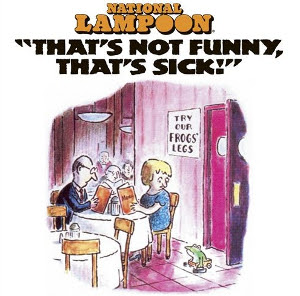
But really the main thing that comes to mind - and "come" is the operative word - is "Hite Report Disco", a raunchy spoof song that appeared on National Lampoon's That's Not Funny, That's Sick - arisqué comedy album my brother bought and which got played endlessly in our house. Such that many of the sketches I can remember word for word. I could certainly replicate the way the just-post-orgasmic man in "Hite Report Disco" says "grrrrrreat!!!" and the aggrieved tone of his unfulfilled lover muttering "great for you maybe".
(Although listening to the song again, the National Lampoonists have failed to grasp the import of Hite's discoveries - the unsatisfied woman in "Hite Report Disco" really ought to take business into her own hands if she wants results)
The most striking thing about this documentary is not the disappearance aspect (her fading from fame and what followed). It's, well, the appearance of Shere Hite.
You expect some kind of fairly frumpy scientist - unconcerned with the fripperies of personal appearance - or at most someone respectably dressed in reasonably smart professional clothing.
But instead here's this absolute glamour queen clad in clothes that are decidedly
un-1970s, harking back to some much earlier idea of elegance and chic.
With her creamy complexion, piercing blue eyes, tall and willowy figure, and cloud of strawberry blonde hair, Hite looks like a Fassbinder heroine.
The name "Shere Hite" itself seems like some quintessence of glamour - "sheer" indeed.
It's like a movie star name, from the 1940s.
Even in her early pre-fame days, when she was struggling to make ends meet, Hite loved to surround herself with exquisite things - beautiful clothes, beautiful decor, beautiful furniture and ornaments and pictures.... all in a style of opulent luxuriousness dating back well before mid-century modern aesthetics... back to the Golden Age of Hollywood - the sort of dated sense of elegance and feeling for the "finer things in life" you'd associate with Norma Desmond.
I don't recall it being mentioned in the doc, but I'm sure Hite loved perfume - she must have wafted behind her the heady scent of the most classic and expensive fragrances
In the early days of her research, which was under-resourced but expensive, involving the mailing out of thousands of surveys and then the painstaking collating of the highly detailed data that arrived in response to the large number of questions... in order to keep herself subsisting (and perhaps also maintain some of her expensive habits), Hite worked as a fashion model.
She also was a life model for the illustrator Robert McGinnis, a collectable cult figure renowned for his movie posters and pulp paperback covers. Hite has been described as McGinnis's muse: she was his favorite model and her posed image proliferated in endless painted variations as the stylized glamour girl on the front of all kinds of romance, crime, and spy novels.... the kind of pink or orange edged paperbacks you used to find at airports or in the rotating racks of a convenience store or gas station....
Yet despite not just propagating - but clearly being personally enamored with - all these increasingly behind-the-times and reactionary images of femininity (the very sort of imagery and archetypes that Betty Friedan and German Greer, with The Feminine Mystique and The Female Eunuch respectively, wished to demolish) - despite posing for Playboy... Hite was a committed feminist, involved in the women's liberation movement via N.O.W.... a participant in demonstrations and activism... and independent-mindedly and determinedly dedicated to her research into female sexuality,
That work was demystification in the Our Bodies, Ourselves mode - about exposing the
graphic genital truth of female sexual response, the fleshy facts of the mechanics of orgasm.
The gulf between the two fronts of activity - the surface illusion, the carnal truth - is fascinating. As is the way that she pursued both with the exact same degree of passion.
Not for her the throwing of cosmetics and brassieres and lingerie into the Freedom Trash Can, as done by second-wave feminist agitators New York Radical Women at their Miss America demonstration.
Hite would have been "what a waste of good beauty products!"
She was at once feminist and post-feminist (or is it pre-feminist?).... affirming the mystique of femininity as another form of power... accepting the idea that gender is a performative construction...
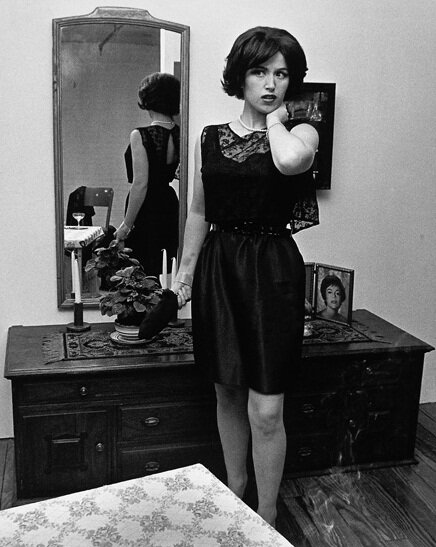
The fashion and illustration work in an odd sort of way reminds me of Cindy Sherman... True, she was not the auteur of these images, McGinnis was... but Hite was something close to a collaborator in that body of work... as she was with the pictures above, and below, done with the German photographer Iris Broch.
The photographs of Hite, and the book covers based on her image, are like the material, the archive of archetypes and poses, that Sherman recreates for her work.
"Others might try to break open that web of mirrors, but Sherman's way of revealing it is just to keep on skilfully turning the kaleidoscope where a few fragments of fantasy go a long way"
- Judith Williamson, Images of 'Woman', 1983
Actually, thinking about it, Hite's sense of style (behind the times, expensive, vaguely patrician) was not unlike the more or less contemporaneous women known as theSwans - the coterie of upper class society women that Truman Capote mingled with and then cruelly satirised in Answered Prayers. As dramatized in the recent Feud: Capote vs. The Swans.
Second only to the Republican Christian women who sabotaged the Equal Rights Amendments, the Swans were the high-profile anti-feminists of the era - trophy wives whose entire lives were dedicated to conspicuous consumption, socializing and society events, gossip, pecking-order disputes.... and affairs. These were often accomplished and brilliant women, but their abilities were penned entirely within the domain of appearance - their own physical appearance, which was immaculate and expensively achieved, but also social appearance: maintaining the facade of a perfect life. (Okay, there was a bit of noblesse oblige philanthropy and that kind of thing - as much done for show as for altruism). There was a rigid and total specialization of roles within the marriage: the wives handled all the inessentials that make life pleasant, while the husbands got on with the business of running the world.
One of the things I discovered during my research on Shock and Awe was that the teenybop end of glam 'n' glitter was synonymous with the discotheque - the local disco that every decent-sized town had by the early '70s. There was also a burgeoning economy of mobile deejay systems for hire. Glam was stomp-along and shout-along music, a domineeringly prominent drum sound being a fixture of records that were built for dancing.
Reviewers often described singles by The Sweet, Suzi Quatro, Mud, et al, as "disco music" or "disco fodder". Gary Glitter's "Rock and Roll, Part 2" became a hit not through radio play but through the discos, gradually breaking out as a chart entry after sixteen weeks. It took nearly four months of dancefloor spins before it got its first play on the radio!
Although bands like Slade were big live draws and mightily rocked crowds, for the most part the pop success of glitter rock was won not through gigs but through records.... the tours came after the chart hits.
The more astute and teenmarket-attuned record labels, like Bell, started to do out-reach to local deejays, sending them promos and in some cases getting feedback about which records were igniting the disco dancefloor. This would influence their decisions on whether to proceed to a proper pressing and a promo push with adverts in the music papers and pluggers pestering radio.
In short: for several years before disco meant what we think of when we hear the word "disco" - black music - disco in the UK meant white pop-rock aimed at teenyboppers.
And one of the reasons why some of the big glam 'n 'glitter artists went funk in '74-'75 - Bowie, T. Rex, Glitter - is that a shift in teen taste was happening in the discos: from stompy big-beat rock to the sway-and-shuffle of Philly soul and Van McCoy / Hues Corporation / George Macrae style soft-funk.
One type of "disco music" was being displaced by another type of "disco music".
So abjectly was Bolan in need of a hit in 1975 that the single "Dreamy Lady" was credited not to T.Rex but to T.Rex Disco Party.
^^^^^^^^^^^^^^^^^^^^^^
Here are some snippets from my research
June 5th 1974 Melody Maker piece by Robert Partridge and Chris Charlesworth, looking at the differences between the pop scene in the U.K. and U.S.A.
“The New Pop in Britain has been broken through the discotheques. Suzi Quatro, Gary Glitter, Mud, Slade, The Sweet... all of them make good dance records…. But in the United States there is no equivalent discotheques, no natural outlet for the New Pop.”
They also point to a lack in America of kids-oriented TV shows with pop content of which there were several in Britain.
September 14th 1974 Melody Maker feature "Going to A Go-Go", by Geoff Brown and Laurie Henshaw
Jonathan King and his UK Records label use discos as a test market. King will take a demo to a club, gets the deejay to put it on, and see how kids react.
Bell Records - which in the States had a history of working with pop soul - used similar methods in the UK.
After the late Sixties, when “kids had stopped dancing and were to be found slumped in comatose heaps around the floor rather than stomping or clumping or bumping on it”, there was a revival of danceable pop:the kids “emerged from their deep sleep” and “attention returned to the feet. To the beat. Slade stamped....T. Rex boogied… and every other manifestation of “newpop” put out 45s in 4/4 time ideal for playing loud to the accompaniment of flashing lights and flying limbs.”
Bell drew up a list of every club in the land -- with information about the type of kids, the type of records played and the time in the night at which they were played.
When deejays flipped Glitter's "Rock and Roll, Part 1" over and played the near-instrumental B-side "Rock and Roll, Part 2"... “the Paunch was launched”
Glitter's producer Mike Leander describes the disco as “a sort of market research.... We... are with a record company [Bell] that has terrific contacts and connections on a person to person basis with deejays in discotheques.... When a record is about to come out we now service around 600 discotheques with copies”
Deejays, because of “their good relationship with the company will give a call back and tell us the reaction, especially if it’s been a good one. You’ll know pretty quickly. Either the place’ll start jumping up or the kids drift off the dance floor and sit down. The deejay is a really important cog in the machine… he’s a very good barometer.”
"Look at it is this way. There are, say, a thousand discos throughout the country each filled with 2,000 kids. Now they’ll play a popular disco record three times a night and they’ll play it six nights a week. On a national scale that’s amazing promotion.”
"The kids’ll start going into their local record shop and ask dealers for a copy. The dealers normally only stock the top 30 but in one area they’ll become aware over, say, a two week period that they’re losing a lot of sales, because this one particular record isn’t in stock. So after 40 or 50 kids have been in asking for the record and this happens in several areas the dealers will start ordering a dozen or maybe a few dozen copies and this feedback will reach the factory. They’ll notice they’re receiving 300 to 400 orders a week for a record. From the factory, this will filter back to the company itself.”
But there are some records that kids love to dance to but don't necessarily want to spend 50 p to buy as a single.
Leander: “I'm personally going through a period of making disco hits but I'm not setting out to be a producer of disco records only. I'm making records to be sold."
Side panel on Mobile Discos
Roger Squire used to run his own mobile disco but now runs Disco Centre, a company that sells or hires disco units and lighting equipment for mobile deejays
Squire's business is booming - his annual turnover is £250,000
He reckons that there are 20 thousand to 25 thousand mobile discos in the UK and about 40 thousand deejays in the country.
Your average Mobile disco is a two man operation -- the deejay who does the patter and has the personality + a technically minded pal.
They play at weddings, Masonic dos, football club functions...
Average work rate: from two nights a week to seven nights at week.
Fee ranges from £15 to £18
c.f. what a Radio One deejay can charge for a gig: £250
Incidentally, the weekly music paper most plugged into this corner of the music market was Record Mirror. Specifically RM writer James Hamilton and his Disco column. This started in September 1974 around the time the UK meaning of "disco" decisively shifted from glitterstomp to black American music, but clearly is in continuity with the fact that Record Mirror was the most teenybop-friendly of the four weekly music papers, the one with the youngest and most female-leaning readership, and that had pin-ups of the pop idols, along with a column penned by Marc Bolan.
That said, Hamilton's column was squarely aimed at jocks - indeed he was a deejay himself, with deep roots in the soul scene. As time went by, Hamilton got into scrupulously noting the b.p.m. of each track reviewed, and indeed in his capsule reviews even noting the changing b.p.m of different segments of a tune, if the tempo fluctuated.
There was also deejays who were "residents" at a factory or workplace, taking requests, keeping the workers's spirits up
(via actress Kika Markham's memoir of life with actor-husband and left-wing activist Corin Redgrave, here reviewed by ultra-thesp Simon Callow)
"... When he was playing Pericles at the Globe, he had a major heart attack, while delivering a speech in Basildon on behalf of some evicted Travellers. He recovered physically, but never fully mentally... Though Redgrave could still speak, his memory was destroyed; its disappearance meant the loss not only of his past, but of theirs.... This sort of thing is tragic for anyone, but when it happens to an actor, it takes on a particularly lurid quality because everything becomes a form of theatre. "Lovely to see you," says Redgrave waking up one morning. "Your nose is very nice." "Do you know who I am?" she says. "Of course I know who you are." It's as if, she says, they are reading a script by "someone masquerading as Beckett". When the nurse asks what he would like to eat, he says, "Shotgun". Great line. On another occasion, still in the hospital, in his gown, he becomes upset because he doesn't have his makeup towel or mascara. "When do we start the dress [rehearsal]?" he demands. The theatre is the only remaining reality for him: he tells a fellow patient, Ann, that she needs to check her lines. The play, it appears, is Three Sisters: Redgrave tells her that he doesn't need to look at his lines as he has been understudying the play all his life. He rages at his therapists: "People pay to see me … I am special."
"The metatheatrical nightmare continues; King Lear, Shakespeare's supreme account of the breakdown of a mind, threads its way through the book. Redgrave had appeared in the play as a boy, saw his father's famous performance in it, played Lear himself.... He even recorded the play for radio, before doing it at Stratford.... As if living out the play, full-blown madness erupts within him; he becomes cantankerous, violent. In an insane parody of his former political position, he believes that Kika and his sister Vanessa are state agents, and demands police protection from them; in the end he is taken into hospital....
"But this too passes, and he resumes some semblance of normal life. He becomes extraordinarily emotional and rather naive – a long way from the Corin any of us had known....
"Markham quotes brilliantly from RD Laing – "we are acting parts in a play that we have never read and never seen, whose plot we don't know, whose existence we can glimpse, but whose beginning and end are beyond our present imagination and conception"...."
Corin Redgrave, absolutely thesp-tastic
Kika Markham in a great Dennis Potter Play for Today






.jpg)
.jpg)


