
Tuesday, April 16, 2024

Tuesday, April 9, 2024
Videogame Killed the Radio Star
An interesting short film about David Bowie's co-creation of the 1999 game Omikron: The Nomad Soul.
Which the album Hours was the soundtrack to, an attempt to give the game "a heart"
I confess this was new to me... my interest in his activities really flags from the late '80s onwards.
A couple of things that struck me watching the film
A/ Omikron's co-creator David Cage is described as a games auteur, someone respected more than enjoyed, written about more than played... "Edgy". Now, granted, I know next to nothing about games but it struck me that from what I could see there, in terms of look it is looks much like every other game... the way the camera moves... the fight scenes ... and as the mini-film concedes, it is an adventure game.
B/ the film makes great play about how ahead-of-his-time, advanced in his thinking, Bowie was when it came to all things digital... First pop star to have his own online music retail system, long before iTunes and Apple... many other internet-innovative things I've already forgotten since watching this short video... And you've probably already seen elsewhere the clip they use of the Dame (with terrible hair and awful shades) proselytizing about how the Internet is going to change all our preconceptions about media - "for better or worse" - and with it human consciousness... He sounds like a wide-eyed Silicon Valley tech-guru... jacked up on issues of Mondo 2000 and one too many smart drinks.
Thing is, all this modish, modem-ish stuff he did... none of it had any lasting impact, nobody remembers it... It's all just trendy piss down the latrine gutter of history.
If Bowie endures, if he'll be remembered in a hundred years, it'll be for those creaky, analogue things known as words-and-music... Oh, and a few images: the costumes, the albums covers, iconic photographer's shots, some of the videos or TV appearances...
It'll be for the human yearnings disguised artfully behind his various masks and costumes.
Thursday, April 4, 2024
hair metal a decade too soon
"New York Dolls go to Studio 54" is how I describe them in S+A
A parallel noticed at the time

And then of course the names - Sylvian / Sylvain, Jansen / Johansen - are the giveaway
Looking and listening to "Adolescent Sex" again, it's like the sound and the look of the song / promo is entirely sourced in the guitar break in "Amazona"
But the other thing about the image is that it is hair metal a decade too soon
I don't understand why "Adolescent Sex" didn't do a "Welcome To the Jungle" and instantly propel Japan to Guns N' Roses level
(Not that I would want to have foregone their growing-up so exquisitely)
In this publicity photo from 1977 they look like they belong on the Sunset Strip in 1987

Actually what they look like is Def Leppard.

Or Hanoi Rocks.

Another 1977 image is totally hair metal - and again, like a premonition of Axl Rose, from the reddish blonde hair to the ice cream face and the hairless chest
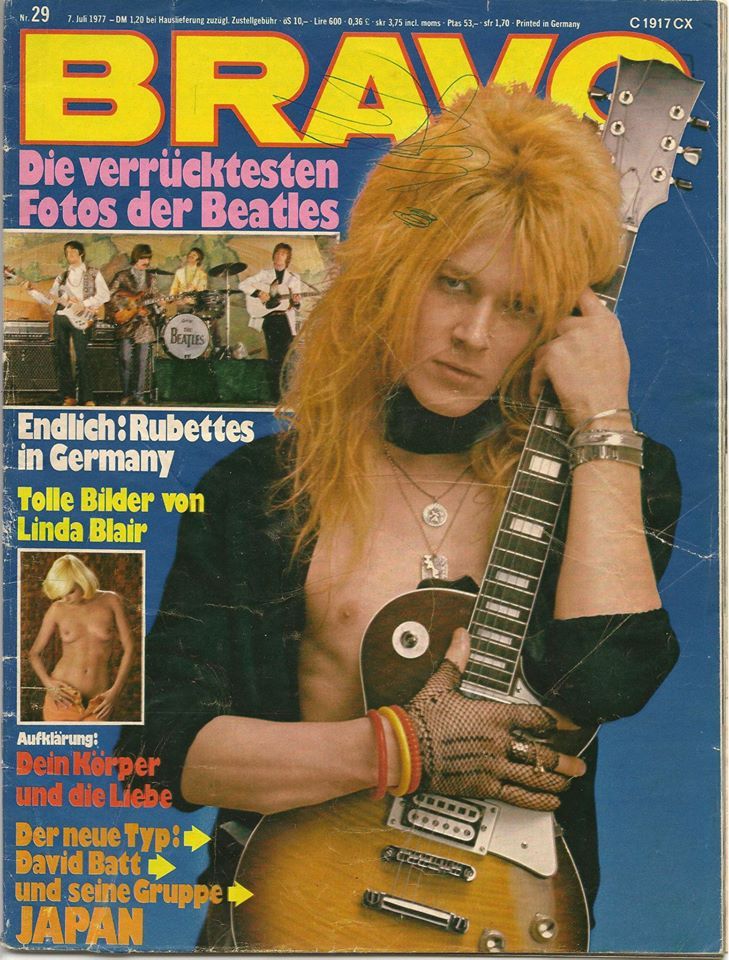
Ooh, how funny - they identify him on the cover by his real name David Batt, not David Sylvian
How the single was pitched to the public


Two different crotches - same hand, though!
Or maybe it's the same crotch, different trousers?
Supposedly they had an ad - or maybe it was A stage projected image - around this time, of David Sylvian, bare-chested but with female breasts.
Sometimes I'm not sure if I came across that in my researches or just dreamed it!
Hmmm, maybe it's something I heard when I interviewed Simon Napier-Bell, who managed them.
Re. the discorock feel of the tune, they were actually signed to Ariola-Hansa, a disco label

Oh! you pretty thing!


Sylvian, of course, very embarrassed by this debut album and whole first look-sound
This era doesn't have quite enough killer tunes though - nothing that would inspire you to dream up a whole counterfactual universe where Japan invented pretty-metal, make-up metal, glam metal, peroxide and blow-dry metal, a decade ahead of the game, like "Adolescent Sex" does
Such poseurs
(I know it's not an official video, but a fan creation using this)
Addendum: below a couple of ancient Blissblog posts about David Sylvian and Japan, in response to this K-punk celebration of the groop circa Tin Drum, titled "The Barthes of Parties"! "Adolescent Sex" pops up towards the end...
The escape artist.
Mark’s mini-essay on Japan is so immaculate and exquisite, it seems almost churlish to say that, actually, I find “Ghosts” rather a moving song. I’m not alone either--there’s the missus (possibly America’s #1 Japan fan-- a lonely breed), and there's Goldie (he sampled it on Rufige Cru’s neglected classic “Ghosts of My Life”, a masterpiece of svelte darkcore), and Tricky ("Aftermath" has a sample from "Ghosts", right, or a lyric-quote?), and maybe even Dizzee Rascal (judging by the the Sylvian-Sakomoto vibe on ‘Sittin’ here’ and “Do It”, the two melancholy songs that bookend Boy In Da Corner).
Carrying on previous trains of thought, I suppose my question is: would it actually diminish the song to believe it had some source or emotional referent in David Sylvian’s real life? To take it as both haunting and haunted. He’s very stylized as singers go but it seems like “beautiful sadness” is something that runs through a lot of his work (along with the quest for serenity) and you could see him as having less to do with a mannequin like Steve Strange and more with Scott Walker, or Nick Drake, or even Frank Sinatra (melancholy given poise, pain contained through elegance). Or Ian Curtis--“Ghosts” in some ways seems like a sister song to “Love Will Tear Us Apart”.
Whenever I see someone who has pulled off a really drastic form of self-reinvention, gone all the way with artifice and masquerade--be it Strange, Numan, Leigh Bowery, Marilyn Manson--I always wonder: what are they running away from? It takes so much energy to do that and to maintain it. (I can barely muster the strength to look halfway presentable to the world).
With Sylvian, perhaps the word “Catford” is explanation enough. No slight to that town but if it’s like 95 percent of the UK or anywhere else for that matter, then you can imagine why the sparkle-starved, culture-famished David would want to dedicate his life to exquisiteness, alien glamour, forbidden colours, to turn himself into a perfect surface, to get away and never go back. But there’s something more, I suspect: thinking of him performing "Ghosts" on TOTP, the excessive poise and stillness, the statuesque quality of his vocals (a frieze of emotion, almost), the perfectly made-up blank white expressionless facade, to me it all screams internal struggle, damage in the depths. Real ghosts in his real life.
“Lines of flight” always carry with them traces of what’s left behind. Can we even conceive of escape or reinvention of the self without registering what's being escaped from, or acknowledging the raw, base matter that is remoulded into a human art object?
I think you could work up another reading of Sylvian, not opposed but supplementary to Mark’s.
It might cue off Penman’s riff about class and Bryan Ferry’s voice, how its alien-ness was produced by the struggle of a Geordie trying to sound debonair --and how that slightly grotesque quality disappeared when he perfected the po(i)se and shed the last traces of Tyneside. (Joy says one of her Japan fan acquaintances had managed to find a very early radio interview with Sylvian where he's talking with a thick Catford accent--again the struggle, the effort that goes into changing one's voice).
It might then proceed to examine Bowie/Roxy and the glam end of artrock, its motor fantasy of stepping outside the lowly world of production into a sovereign realm of pure unfettered expression and sensuous indulgence, an imaginary and fictitious notion of aristocracy (more Huysmans than real lords who have to do humdrum things like manage their estates, juggle their investments, do a bit of arms dealing). It might pause to consider briefly the disillusionment of actually achieving the supermonied aristo life--Ferry, condemned to mooch jaded forever through art openings, fashion shows, all tomorrow’s parties (that old tis better to journey than arrive line).
It might also look at the history of Orientalism and its relationship with dandyism. The Far East and its codes of etiquette, the extreme stylization of emotion in its art; grace and symmetry. (Didn’t Barthes write a whole book about Japan--the country, not the group!--called something like Empire of Signs, one of its ideas being Japanese culture as a realm of surfaces, where the depth model is abolished--he had this idea that the Japanese don’t think eyes are windows to the soul, they see them as attractive but flat planes).
There must be some connection between artrock’s ruling-class fantasies and ideas of China or Japan as extremely well ordered, disciplined, hierarchical societies. There’s a bit of totalitarianism chic going on--Mao, the Emperor, Mishima etc--that parallels Bowie’s “what this country needs is a really strong leader” flirting with fascism phase, or Iggy with his “visions of swastikas” and plans for world domination (and those are lyrics from “”China Girl” come to think of it). As reheated by the New Romantics: Spandau Ballet’s Journeys To Glory with its noble torso statuary on the cover and Robert Elms’s faintly fascistic sleevenote, the whole idea of a Club for Heroes.
Glam's tendency (through its shifting of emphasis toward the visual rather than sonic, spectacle rather than the swarm-logic of noise and crowds) towards the Classical as opposed to Romantic. Glam as anti-Dionysian. The Dionysian being essentially democratic, vulgar, levelling, abolishing rank; about creating crowds, turbulence, a rude commotion, a rowdy communion. Glam being about monumentalism, turning yourself into a statue, a stone idol.
bit more on Sylvian...
“Ghosts” is one of only two things by Sylvian I paid money for, so maybe Mark is right about it being exceptional in the Japan canon for its overt emotion; other stuff, like “Art of Parties”, sounds great but was a bit disengaged for me. But per Mark’s reading, maybe that’s what great about it, the slink of the surfaces.
The other thing was “Bamboo Music/Bamboo Houses” by Sylvian-Sakomoto: amazing drumming
The China/Japan totalitarian chic thing doesn’t run deep, sure… it’s appropriately shallow, flirtation with decontextualized signifiers in true glam style. Still I notice that there’s a song called ‘Communist China’ on the first album, while on the Teutonic tip there’s “Suburban Berlin” and “Nightporter” which I assume is inspired by the Dirk Bogarde as Nazi-in-hiding movie. They also have a tune called “.... Rhodesia” bizarrely enough---surely the only rock song about this white-power pariah of the world community state, although I daresay there's a roots reggae tune of the same title.
That bio Mark links doesn’t mention “class”’ as such (maybe press releases should come with sociological data). But I’d hazard a guess re Sylvian: he’s from that upper W/C, lower M/C indeterminate greyzone whence so much great UK pop stems.
The later stuff’s not as barren as Mark makes out (although I once dismissed Sylvian solo as “jet-set mysticism”, while Jonh Wilde’s description of his voice as sounding like hair lacquer struck me as uncomfortably apt). But the “Gone To Earth” instrumentals are lovely in a Durutti/Budd/John Abercrombie sort of way, while things like “Orpheus” and “Waiting For the Agony To Stop” have a certain Scott Walker-goes-ECM grandeur.
But I would swap his entire solo career for “Adolescent Sex” the title track of the first Japan album. It’s like disco-metal or something, its sashaying glitterball raunch and cokane dazzle suggesting a whole lost future or parallel pop universe. It’s like Guns N’Roses “Welcome To the Jungle” produced by Daft Punk circa “Digital Love” or something. This totally plasticized, artificial rock music that still rocks. (The only thing I’ve heard like it is some tracks made by Last Few Days, a second-tier industrial group who circa ’89 totally reinvented themselves as this glammed avant-raunch outfit and got a major label deal. Then they unwisely went house and that was that).
It’s interesting how Japan (and Foxx-era Ultravox too come to think of it) had so many of the same inputs and reference points as Siouxsie & the Banshees---Roxy, Velvets (Japan covered ‘All Tomorrow’s Parties’), Dolls, Eno, Bowie, similar movies and books too I’ll bet, similar flirtations (that decadence/fascism/S&M/voyeurism) and shtick (ice queen, don’t touch me, regal remoteness, I am a machine, metal will rule in my master scheme).
And yet the Banshees were deemed "punk" and all through this period Japan and Ultravox were jeered at as glam johnny-come-latelys, throwbacks. If you reconfigured glam as the true 70s revolution/upheaval in 70s UK pop, and made punk into its aftershock, you might get some interesting results.
Mark quotes Penman on the later Ferry stranded in an “autumn swirl of shriveled or dying signs (that once were lustrous: 'dance' - 'drug' - 'love'), making solemn play of an immensely empty escape in the facades of an eternal tone - windswept, misty, limpidly sensual, banal.”
The comeback Roxy is something I’d probably have mostly disregarded at the time, except in an idle radio enjoyment way--not sure I’d even heard the original Roxy then, so had no disappointment or betrayal to bring to the table. But I always really liked the glint-swirl synths of “Same Old Scene” and in retrospect this wanly elegant later Roxy/Ferry--“More Than This”, “Avalon” --has a certain narcotic allure. Weirdly, it’s like Ferry’s arrived at his own wispy aristocratic version of ambient music.
Monday, April 1, 2024
"aristocratic glam"
Mark Fisher would say that glam is intrinsically aristocratic.
But it's supposed to be a Tom Ripley type interloper - someone from the lower echelons of society who sneaks his way in. Borrows the clothes and apes the manners of the nobs. Artfully, cunningly, through unstinting attention to detail, becomes "one of them".
As if to the manor born - but actually an upstart of lowly birth. A parvenu.
Glam as aesthetic class war. Usurpation in the realm of symbols and representation.
Although the wealth and fame thereby won can enable a literal form of infiltration.
Bryan Ferry as pit-worker's son who first imitates - and then penetrates - impregnates... the actual upper classes. Marries into blue blood... breeds some Eton-bound hunting 'n' fishing brats... hangs out with Dukes and discusses vintage wines.
Or - fictionally - the narrative arc of that silly film Saltburn.
What would Mark say, then, about an actual blue-blood doing glam?
Hark at this for a pedigree!
Daphne Guinness - socialite / fashion model / fashion writer / curator / film maker / actress turned pop singer.
Scion of the Guinness dynasty and the Mitford line.
Her grandmother was Diana Mitford, who divorced Guinness and married Sir Oswald Mosley, leader of the British Union of Fascists.
Daphne grew up moving between country houses owned by her family in England and Ireland and a villa in Spain. Salvador Dali was a family friend. Later lived in New York (where her sister worked as a PA to Andy Warhol).
Muse to fashion designers Alexander McQueen and Karl Lagerfield. Friend to Isabella Blow
Has her own Comme des Garcons scent, named Daphne
Encouraged by David Bowie to purse music. As a result...
Produced by Tony Visconti
Claimed to known nothing about her step-grandfather's politics when Mosley's death announced.
And yet here is a song named after hierarchy-obsessed Emperor-admirer Mishima!
"Named after the renowned Japanese poet Yukio Mishima, who Daphne was introduced to by a Japanese nanny she had when she was between the ages of three and five. Her name was Etsuko, she recalls, and when I was three and Mishima died, my father found me on the back staircase trying to commit seppuku. I said to him, 'I think I'm Mishima.’ The track also features traditional Japanese instrument, the shamisen. I bought it when I was in Japan with my friend Nori. He took me to this man who was about 85 and still making shamisens and they couldn't believe that I wanted it."
Introduced by her nanny!
New single
A bit "Warm Leatherette", a bit Deborah Evans-Strickland from Flying Lizards, a bit Marianne Faithfull
"I might look like an icicle, but underneath I'm a volcano"
This triptych is - sonically - a bit sub-White Noise / Julie Driscoll / Broadcast
I've heard.... more wieldy voices, let's say.
Discography includes Optimist in Black (2016), Daphne & the Golden Chord (2018) and Revelations (2020), the contents described variously as "drama-pop with a gothic tinge", "glam-rock-ish," and "aristocratic glam fuelled by wit, character and a clear and abiding love of rock'n'roll".
"I'm a rather private person - and armor to me is many sorts of masks... Japanese Noh theatre... make-up... you become a different persona"
It's a bit Glam 101.
"I like haute couture because it's the last vestige of something that's been an integral part of Western Civilization from very early on"
Last-vestige-ism = a bit of a political giveaway.
Relates perhaps to my idea of fame as a secular version of royalty / royalism.
At the top I wondered what would Mark Fisher think of a member of the actual ruling class becoming "glam".
To me, it would seem to be... not much of a journey, more a case arriving back where you started, or confirming what you already are.
So the opposite of the pop idea of self-reinvention.
Concentration of wealth addendum:
"In 1987, she married Spyros Niarchos, the second son of Stavros Niarchos... Her $39 million settlement, obtained at the time of her 1999 divorce, was added to her Guinness inheritance."
More recently partnered with philosopher and public intellectual Bernard Henri-Lévy, whose own inherited fortune had grown by 2004 to be in the vicinity of 150 million Euros - probably more now unless he's a complete bumbler.
What does it say in the Bible?
'For to everyone who has, more will be given, and he will have abundance; but from him who does not have, even what he has will be taken away.
Thursday, March 28, 2024
Their Way
Never fully understood the term "chewing the scenery" until I saw this.
Dorothy Squires certainly "did it her way" - more on that at the bottom.
But first, some other "My Ways"
Presumptuous, moi - Robbie Williams as new-school-crooner
Nina Hagen's is a cover of a cover - her rendition is modelled on the Sid Vicious version - same sickening downswoop glissando orchestration to kick things off, same mis-wordings, same sneers, same punke rocke riffola.
Shane MacGowan likewise emulates the Vicious versh rather than ol' Blue Eyes's
Now here's an actual thesp doing it, Edward Woodward - but ironically, underplaying it, c.f. the hamspectacular Squires at least
An interesting reading from Nina Simone, another singer who'd been through ups and downs
There's HUNDREDS more versions - seems nearly every major variety / middle-of-the-road type singer had a stab, along with many seemingly unlikely performers (Aretha Franklin).
The Vicious-style punk shlock take is a mini-tradition river in its own right.
Here's another of the Rat Pack having a gnaw at it - Sammy Davies, Jnr
Different song from Ol' Glass Eye but a similar sort of sentiment, verging on a rewrite
This sort of battered but still-standing grandiosity seems almost inherent to being a showbiz trouper, the sense of oneself as a Legend and a Survivor
You could imagine any number of country singers doing a "My Way" - looking back on the wreckage of their many marriages and their alcohol + uppers addled trajectories from rags to nouveau riches and thence to ruination.
Couldn't find any rap versions - perhaps the whole genre is a kind of cover of "My Way"?
I once saw a TV program dedicated entirely to "My Way" - the story behind it, and people's feelings about it. This is a long time ago. I was struck by how many people - meaning ordinary folk in the street, canvassed for their opinion - disliked the song. Beyond the breast-beating, they disapproved of its rampant egomania and individualism. These tended to be people who - one guessed - might be teachers or librarians or otherwise working in the public sector.
And I could see their point: the song is obnoxious, not a good philosophy of life at all, and unreflective of reality (these arch-Individualists always have an extensive support system enabling them, spouses and assistants and so forth).
It's a sort of Ayn Randy song, really.
Still, I confess that I've always had a soft spot for it, even before Vicious's reinvention.
Has Nick Cave ever done a "My Way", and if not, why not?
Some of his hero Tim Rose's songs seem to come from the same place - "I Gotta Do Things My Way".
Third track on this great album
This shtick is at the heart of Tim Rose's act and informs many of his song choices e.g. "I Gonna Be Strong".... even the songs of regret like "Long Time Man" and "King Lonely The Blue" and "Where Was I" bolster this tough-guy persona. As crystallized in the bizarre, almost drooling liner note for the debut album penned by David Rubinson:
'Tim Rose hits you in the belly.... He is a man, and he is his own man. His songs are about his loneliness in a world of neuters.... He must be swallowed whole--progressively detailed analyses...serve only to uncover the further depths of this man's masculinity.... And if you choke, and cannot consume--don't be polite--for the last thing Tim would ever do would be to apologize for sticking in your craw.'
Now, did "Je Ne Regrette Rien" get written before "My Way"?
But back to where we started: Dorothy Squires.
Quite a life....
I've skipped the whole first 40 years of singing success, buying 14 bedroom mansions with her songwriting hubby (many international hits under the belt, for others as well as Squires), etc. Straight to the juicy, increasingly out of control stuff, via Wiki:
Squires met the actor Roger Moore at one of her parties at her mansion in Old Bexley, Kent. Moore, who was 12 years her junior, later became her husband when they married in New Jersey on 6 July 1953. She later said, "it started with a squabble, then he carried me off to bed." She introduced him to various people in the Hollywood film industry. As his career took off, hers started to slide. Their marriage lasted until 1961, when Moore left her. He was unable to marry legally until Squires agreed to a divorce in 1968 – the day on which Squires was convicted of drunk driving.
Returning to the UK, Squires had a career revival in the late 1960s at the age of 55 with a set of three singles that made the UK Singles Chart, including a cover of "My Way". New albums and concerts followed including concerts at the London Palladium, Royal Albert Hall and the Theatre Royal, Drury Lane. She issued a double album of her Palladium concert.
In 1971, she filed the first of 30 court cases over the next 15 years. In 1971, she successfully sued the News of the World over the story "When Love Turned Sour", and was awarded £4,000. In 1972, she took out a libel action against the actor Kenneth More, who had mistakenly referred to Roger Moore's girlfriend Luisa Mattioli as Moore's "wife" when he was still legally married to Squires. Michael Havers acted for Kenneth More, who won the case. In 1973, she was charged with high kicking a taxi driver who tried to throw her out of his cab. She was also one of several artists charged with bribing a BBC radio producer as part of a scheme to make him play her records; the case was dropped.
In 1974, her Bexley mansion burned down, from which she escaped with her dog and all her love letters from Roger Moore.
She then moved into a house in Bray next to the River Thames, which flooded three weeks later.
By 1982, she had been banned from the High Court, having spent much of her fortune on legal fees. Her numerous lawsuits caused the High Court on 5 March 1987 to declare her a "vexatious litigant", preventing her from commencing any further legal actions without the permission of the Court. In 1988, following bankruptcy proceedings, she lost her home in Bray, to which she returned the following night to recover her love letters from Moore. Her last concert was in 1990, to pay her Community Charge.
Squires was provided with a home in Trebanog, Rhondda, South Wales, by a fan, Esme Coles. Squires retired there, becoming a recluse, and died in 1998 of lung cancer, aged 83, at Llwynypia Hospital, Rhondda. Her remains are interred in a family plot in Streatham Park Cemetery, south London.
Thing is, she recorded "My Way" before most of the really crazy stuff happened. It's almost like doing the song pushed over the edge into a kind of loose-cannon state of mind: "I will do it my way, you better get out of my way"
I could imagine a play being written about her last years in Trebanog, the monologues, the memories...
Or about the romance with Roger Moore, which has a touch of Norma Desmond and the younger William Holden character in Sunset Boulevard...
Talking of theatricality, "My Way" is a sort of soliloquy, isn't it - Shakespeare goes Vegas.
Tuesday, March 26, 2024
a better future
Let's listen to something better
But why is the affinity between rock and science fiction so strong? And what is the connection that both have with youth?
"Life on Mars?” provides a clue.
True, the lyric isn’t really science fiction. But the song scenario and its emotional tenor do evoke exactly the sort of longings and frustrations that fuel “the desire called utopia,” the poetic subtitle of Fredric Jameson’s s.f. study Archaeologies of the Future.
Bowie’s own account of “Life on Mars?” is that it’s about “a sensitive young girl’s reaction to the media.... I think she finds herself disappointed with reality ... that although she's living in the doldrums of reality, she's being told that there's a far greater life somewhere, and she's bitterly disappointed that she doesn't have access to it."
Formulaic entertainment offers no relief (“the film is a saddening bore” -which I've always heard as "sagging bore" and prefer that mishearing).
TV news presents a panorama of absurdity: “the workers have struck for fame.”
Humanity seems lemming-like both in its futile workaday striving and its preferred forms of escape and relaxation: mere “ mice in their million hordes” swarming to Ibiza or the Norfolk Broads for the annual getaway from it all.
So the question of the title - "Life on Mars?" - is at once an indictment of the sheer mundanity of life on Earth and a sighing entreaty: there must be more than this, an absolute elsewhere."
adapted via
Looking at the lyric, I never noticed before the sustained mouse imagery:
"the girl with the mousy hair"
"Mickey Mouse has grown up a cow"
"the mice in their million hordes"
from the album Glam
Sunday, March 17, 2024
RIP Steve Harley
One of the most enjoyable bits in the research for Shock + Awe was doing Cockney Rebel.
What an odd anomalous sound they had! (I shunted them into a chapter called Baroque 'n' Roll, alongside Queen and Sparks)
And what a peculiar, driven, super-self-conscious frontman / leader, in Steve Harley!
I grew to really like The Human Menagerie and Psychomodo. And was surprised to discover that "Make Me Smile (Come Up and See Me)" was
A/ titled like that, and not "Come Up and See Me", the first line of the chorus, which was how I'd always mentally filed it.
B/ not a sweetly suggestive, sexually inviting song, as the chorus could lead to you think ("come up and see me, make me smile... do what you want, running wild") but a classic of meta-music and insta-self-mythology, seething with spite and bitterness.
Here are some of my favorite Harley / Cockney Rebel tunes interspersed with excerpts from the Baroque 'n' Roll chapter.
Initially besotted with Dylan, he was jolted out of folk-singer mode by Bowie, who showed the possibilities for a new rock theatre – one that took place not just on the stage but in the pages of the pop press. Harley had observed the successful unfolding of the MainMan masterplan– “talk like you’re already a star, act like you’re already a star, and you’ll become a star”. Launching Cockney Rebel, he followed the Bowie / Defries play-book page for page (while also taking style notes from Bryan Ferry). When the band played at Biba’s Rainbow Room, Harley introduced himself as “Mohammed ‘Arley” – funny, but also spot on. His brazen boasting and put-downs of the contemporary scene really did recall the former Cassius Clay’s pugilistic patter of self-hype and goading of his adversaries.
For Cockney Rebel’s first major feature in November 1973, Harley came out swinging, telling Melody Maker that “we’re rehearsing music now which is so hard and tough it knocks me through the roof. There’s a buzz in Cockney Rebel saying we’re on the brink of being big, being leaders not followers, a musical force that others will follow.” Muhammed Ali is sometimes mentioned as a pioneer of rap; like rising hip hop MCs aiming diss rhymes against established rappers, Harley launched his career by squaring up against the biggest name in the biz, as if they were already on a par. “I hope that when Bowie hears Cockney Rebel it’ll knock him sideways and he’ll say ‘...I’ve got to step on it to stay at the top’. I’ll chase him until I either fall flat on my face or make him run. He needs someone like Cockney Rebel… There’s no one around to kick him up the arse.”
The music papers ate up this kind of thing. Harley knew how to give good quote partly because, says Cockney Rebel keyboardist Milton Reame-James, “he read every single line of every single music paper every week. He was really good at following the trends, and he knew the journalists, what to feed the press so that they hadn't really got to think about writing an item — Steve had written it for them.” It was also because Harley had himself been a journalist before he’d picked up a guitar: not a rock writer, but an experienced reporter on local newspapers like Braintree and Witham Times and Colchester Evening Gazette. Working his way up from tea boy to sports editor, he eventually got a brief taste of Fleet Street – including six weeks on the Daily Express, Harley claimed in an early feature– but then gave it up, he said, because he was becoming cynical and ruthless in his pursuit of a story.
.... Learning first from Dylan and then from Bowie, he developed the knack of writing floridly imagistic lyrics – teeming with bitches crucified, suicide streets, painted faces, lips like morgues - that conjured a sense of hidden depths and cutting angles.
Anticipating postpunk bards like Howard Devoto, Elvis Costello, and Kevin Rowland, the tone was often see-through-you scornful, jousting with unidentified enemies or passing panoramic judgement. Unreality rhymed with vanity, Schemeland with Dreamland, ego with Quasimodo, and Nero got a namecheck too. The title of the debut Cockney Rebel album The Human Menagerie gives a sense of how Harley viewed the world – a stew of corruption, fakery, self-deception, bravado and betrayal. Underneath it all bubbled bitterness about the hand – or rather leg - the world had dealt him. Yet the prettiness of the melodies and the quirky, playful arrangements concocted by Harley and his bandmates made the whole package attractive.
.... The single most divisive thing about Steve Harley was not his grandiosity, but his voice. Like his right leg, it lacked strength and stability, yet by sheer force of will he fashioned its weak ‘r’ and wobbly vowels into a mesmerizingly quirky instrument - all fey chirrups, goblin sneers, and shaky soars of would-be operatic emotion. The effect was vaguely repellent… yet gripping.... Harley had learned from Dylan about how you could use phrasing to make something out of a voice that that lacked range and power.
“I was overawed, enraptured,” Harley said of his first encounter with Dylan’s work, which propelled him into a pre-Rebel career as a Dylan-casualty playing for free in folk clubs and busking, doing the whole “harmonica holder and the nasal bit.” It was during this phase that Harley hooked up with violinist Jean-Paul Crocker, the first of the components that made up Cockney Rebel’s unusual sound.. At the age of seventeen Crocker picked up a fiddle for the first time. Applying five years of studying classical guitar to a completely different instrument, he came up with a style that blended elements of rock’n’roll and bluegrass, heard to captivating effect on tunes like “Hideaway” and “Crazy Raver”. Crocker “was able to create this enormous sound that moved and rocked” says Reame-James. The keyboard-player’s own background took in training as a concert pianist, playing for a youth orchestra, and writing music for theatre. Like Crocker, Milton Reame-James “approached the keyboard from the perspective of the classical tradition. I was also very influenced by the jazz players who were using electric piano. That's why I chose the Fender Rhodes – I really admired what Herbie Hancock and Chick Corea were doing at that time. Writing my parts I borrowed from classical music a lot, in a disguised way, changing the notes a bit. Quite often in Cockney Rebel, I’d be playing the left hand from one piece and the right hand from a different composer, a completely different piece!”
Although the rhythm section – bassist Paul Jeffreys and drummer Stuart Eliot – corresponded to the rock-pop norm, the kind of rhythmic structures Harley’s songs followed often seemed more like European vaudeville or folk-meets-cabaret. Factor in the presence of violin and the classical-infused piano, and the absence of electric guitar, and the Cockney Rebel sound amounted to one of the real curios of the British 1970s.
Harley made a huge rhetorical deal about having a guitar-less sound. In interviews, he railed against the cult of the guitar-hero that had ruined rock from 1968 onwards, saying that the Kids “must be tired of screaming guitar licks that say nothing.” He wrote a song, “Tumbling Down”, whose long fade features the sing-a-long chorus “oh dear! Look what they’ve done to the blues, blues, blues.” Guitarists had no place in Cockney Rebel, with their “rude noises” that “couldn’t do anything for my songs”.
But knowing Harley, it seems like the decision not to have a lead guitarist was as much to do with not wanting to share the limelight with a Ronson-type figure. “I wasn’t going to take on anyone who was likely to upstage me,” he recalled of the group’s formation. This only-room-for-one-star-here stance carried through to the songwriting, which was his province entirely. “They had to be guys who didn’t think they could write better songs than me.... I laid it on the line.... I’m the guv’nor and everyone knows it. Five heads are never better than one.” Harley added that it was tricky at first because “I had to find guys I could brainwash into joining me on the strength of my songs”, not having any money to pay for their acquiescent participation in the project. “They had to have total faith in me and the belief I could make them stars.”
Having no guitarist became Harley’s way of upping the ante on glam’s first wave. He picked up on Bryan Ferry’s patter about the lost art of songcraft and talked loudly of being “basically old-fashioned. For me the greatest works of contemporary song writing were by Gershwin, Irving Berlin, Jerome Kern and Cole Porter.” He took the “carry yourself like a star” classiness further too. He boasted about how Cockney Rebel would “spend all our earnings on a good hotel to look fresh” on tour. He claimed that at a time when rock bands came onstage looking like roadies, Cockney Rebel’s roadies looked as smart as the band. “We have the cleanest roadies in the business. They come in, shower or wash and change like us. They’re special, they’re not the average roadies,” Harley solemnly informed NME. At some early gigs, chief roadie Terry Pinnell wore top hat and tails and carried drinks onstage on a silver tray, like he was Cockney Rebel’s butler....
Their debut single “Sebastian” looks like a conscious attempt to situate the band as “glam”, but only in terms of the lyrics, not the music. A symphonic epic, drawing on a 40-piece orchestra, a choir, and the full largesse of EMI’s budget, the song feels like a throwback to the progressive late Sixties, when groups first started integrating quasi-classical elements into the music. The heavy phasing effects that make Harley’s wobbly vocal even more wavering hark back even further to psychedelia. Harley has spoken of the song being influenced indirectly by his LSD experiences, a period when he “blew a lot of brain-cells” with acid and speed.
“Sebastian” doesn’t sound anything like a hit single in 1973’s context. But what did make the single timely and glammy were the elliptical hints of bisexual passion in the lyric (a passing reference to a paramour who’s “oh so gay”, images of a pallid angel-faced seducer with green eye-shadow) combined with the swooning languor of Harley’s vocals. The title itself is a name so overloaded with layered gay associations that it’s become a self-perpetuating tradition: Saint Sebastian, icon of homo-erotic passion; Sebastian Melmoth, the alias adopted by a disgraced Oscar Wilde after his release from gaol; Lord Sebastian Flyte, the decadent aristocratic heir and wastrel of Brideshead Revisited; Sebastian Venable, the aesthete torn apart by rent-boys in Tennessee Williams’s Suddenly Last Summer.... Yet according to Harley “Sebastian” means whatever you want it to mean: its “six minutes of Gothic poetry” dated back well before glam, to his busking days at the start of the Seventies.
Sonically at odds with the times, “Sebastian” flopped totally in Britain. But it became a #2 hit in both Belgium and the Netherlands, and did well in Germany. This success convinced EMI that Cockney Rebel really were potential second-wave glam superstars. Alan Parsons, who had trained under the Beatles engineer Geoff Emerick, was lined up to produce the group’s second album The Psychomodo .
Before the LP was finished, though, Cockney Rebel scored a #5 hit in March ’74 with the non-album single “Judy Teen”. A rare moment of pure gaiety in the Harley songbook, this reminiscence of adolescent sex rides an odd pizzicato rhythm, at once lilting and stilted. The herky-jerky un-rock feel is matched by Harley’s scansion (“all hanky panky” is rhymed with “seldom she bored me”) and the singer’s gelatinous warble, a cross between Fagin from Oliver! and Noël Coward.
The Human Menagerie had contained one or two really eccentric tracks, most notably “Death Trip”: a ten minute, tempo-shifting piece that suggested an alternate world where all music had followed the direction pointed by “A Day In The Life”. Psychomodo plunged deeper still into grandiose experimentalism. Reame-James recalls the sessions as crazily creative, with himself playing atonal stuff on the keyboards and violinist Crocker off on “a wacky trip... doing all sorts of weird things with his bowing... and getting into gizmos - anything with a foot pedal, anything he could do to modulate the sound. We called him the Gizmo King”. Stuart Elliot, meanwhile, laid down super-syncopated breakbeats on “Singular Band,” a song that flipped back and forth between solo drums and sung verses.
The heart of Psychomodo is a challenging stretch that starts with the last track of side one (the droning seven minutes of “Ritz”) and recommences with the first track on side two (the droning nearly-nine minutes of “Cavaliers”). NME reviewer Charles Shaar Murray grudgingly praised “Ritz”, comparing it to Last Year At Marienbad:Alain Resnais’s spatially and temporally disjointed dream-drift through the corridors and gardens of a Central European chateau, which is described, in Alain Robbe-Grillet’s incantatory script, as “this sprawling, sumptuous, baroque, lugubrious hotel... salons heavy with ornamentation of a bygone era.”
“I think ‘“Ritz’ is literally to do with ‘putting on the ritz’,” says Reame-James. “It’s about glamour.” The sound itself is like a sepia-tinted mist of Old World elegance, a haze through which Harley intones heady lines about the eyeless gaze of “clowns in drag” and “the twisted tale of man”.
The sense of decay and corruption intensifies with “Cavaliers,” an uncharacteristically heavy song for Rebel (featuring electric guitar for once, distorted with pedal effects, as were Reame-James keyboards) that rolls out like an endlessly cycling portent of doom. Suicide, masturbation, blow-jobs, absinthe, and crucifixion all figure in one of Harley’s most garish lyrics - a jaundiced panorama of modern times in the vein of “Desolation Row” . What the concept of the cavalier signified to Harley is unclear: a history buff, he may well have seen the parallel between the dandy Royalists and glam’s decadents. The song’s choruses proposed Cockney Rebel’s following as cavaliers, invited them to testify, but the tone was vaguely taunting, with the Dylanesque “how does it feel now you’re testified?”
Cockney Rebel now had a fervent following, after the Top 5 success of “Judy Teen”, and another oddball hit taken from Psychomodo, “Mr. Soft” – a sort of Brecht-Weill polka. Their new disciples copied the singer’s penchant for wearing a bowler hat; some threw them onstage. As the group embarked on a 40-date tour in the early summer of 1974, a real Rebel-mania was brewing: an increasingly paranoid Harley, jittery about the crowds, hired extra security. But then it all came tumbling down....
.... In Harley’s own account of the dispute, the band demanded to write songs for the third album; he wanted to continue the existing set-up of himself as sole songwriter for at least one more album after Psychomodo. Crocker, Reame-James, and Jeffreys refused and announced they would quit after the completion of the 40-date tour.
Harley understood how crucial it was to control the narrative and went straight to the music press, which accepted his framing of the schism – making him both the injured party and the victor. The July 27 1974 issue of Melody Maker reported that “it was entirely Harley’s decision to disband” Cockney Rebel, that he’d been aware of undercurrents of insubordination within the group, and called a meeting to confront them.
“Steve made out it was him who’d split up the band,” recalls Reame-James. “But we left him. In that Melody Maker piece, he actually repeats the same things he said to us: ‘I don't need you guys. I could stand there with four cardboard cut-outs and I'll still be a star.’ And we said, ‘If you don't need us, we're going. That's it. Bye.’ I think Steve genuinely believed that he didn't need us, that he'd be able to get some session guys and it would carry on exactly the same as it was before.”...
Possibly smarting from the fact that Reame-James and bassist Paul Jeffreys had joined the rising post-glam band Be-Bop Deluxe, Harley was still ranting in November when he did a big interview with NME, that perpetual thorn in his side. The piece was tied to his first solo single “Big Big Deal,” on which he played all the instruments except the drums (handled by Stuart Eliot, the only Rebel who’d opted to stay)....
When “Big Big Deal” left no impression on the charts, Harley funneled all the unattractive emotions displayed in that NME feature into a supremely appealing song -- “Make Me Smile (Come Up And See Me)” – that became a career-saving smash: #1 in the UK for five weeks, a million-plus copies sold world-wide, and to date around 120 different cover versions.
Most people took “Make Me Smile” as a sweet, sexy tune, hearing the beguiling chorus title phrase with its suggestions of assignations and afternoon-delight. In fact, the song is “a finger-pointing piece of vengeful poetry,” in Harley’s words - an acrid and very public (if somewhat veiled) kiss-off to the group who “betrayed” the singer’s trust. The song was written within days of the split, with the first verse, Harley has said, probably emerging from a swamp of brandy-soaked self-pity. The lyric indicated just how fearfully Harley had contemplated the abyss of going back to being a nobody again.
Rallying his resources of spite, Harley retaliated with the song that would ensure his pop immortality and (as he put it) pay him a handsome pension. “Make Me Smile” is basically “The Ballad of Cockney Rebel”, a self-reflexive anthem. Harley accuses his erstwhile bandmates of bringing the Rebel “to the floor”, taking everything away from him. And all for the lowest of motives: “metal, what a bore”, meaning money (as if the other Rebels were a trade union striking for a pay-rise). The cooing chorus-refrain about coming up to see him and making him smile was – Reame-James believes - a private message to the band, referring with a sort of soured fondness to the lost camaraderie of the band’s early days. “Steve lived in an upstairs flat in Chelsea, with an entry phone, and we’d always turn up at his place before going off to gigs.” Before buzzing them in, Harley would always answer with a Mae West-like “come up and see me sometime”. “It was his little joke, and we’d hurl abuse into the entry phone. It’d make him laugh.”
Harley himself has said the chorus was simply a taunting anticipation of future triumph: one day you’ll know you blew it, one day I’ll laugh in your faces....
Muhammed Harley reigned supreme as champion: “Make Me Smile” was a bigger hit than his role models Bowie and Ferry had achieved at that point, while Harley’s enemies were in disarray (Reame-James and Crocker did not last long in Be-Bop Deluxe), cut off from the success he’d promised and predicted if only they’d follow his leadership....
Bonus beat: interesting reading here from George McKay, from his book Shakin' All Over: Popular Music and Disability, looking at how contracting polio as a child and the consequent corrective surgery affected Steve Harley. He detects traces, or perhaps uncanny echoes is better, of the trauma and its lifelong effects in the idiosyncratic rhythms of many Cockney Rebel songs - even in his odd style of singing - as well as some of the lyrical themes (the very title Psychomodo with its echo of Quasimodo) and moods.
"The 1970s English pop singer Harley spent three-and-a-half childhood years in hospital, after contracting it in 1953... His long-term impairment consisted of atrophied right leg muscles, related limping gait, and chronic uncertainty of balance....
"Steve Harley’s repertoire included a vocal delivery and lyrics and musical arrangements that drew on tics, pauses, an occasional stutter, masses of mispronounciations, nursery nonsenses. (These are elements of what I call his mal canto.) He limped on to stage to the accompaniment of pop music that could be strikingly rhythmically unusual, driven by a percussive centre that was more than slightly off-beat. Hit songs like ‘Judy Teen’ and ‘Mr Soft’, each a top ten single in the British charts in 1974, were peopled by eccentric characters, and voiced with stutters and echoes, but their rhythms are notable too, for the punctuated or broken stops and silences, and most of all their alla zoppa stepfulness.
"At his commercial peak in the mid-1970s, after glam and before punk rock, Harley presented an image of pomp and disturbance with albums like The Psychomodo and The Human Menagerie, playing the poppy madman and decadent, singing songs of suicide and ‘mild schizophrenia’, as he put it. Although he told me in 2005 that he did not consciously explore any personal sense of disability during the songs of the peak Cockney Rebel years, it is possible to trace some such recurring interest, even from the modest freakery of the album titles alone.
1974’s The Psychomodo presents a fictive figure of combined cognitive and physical impairment, a conflation of the psychotic Quasimodo, who is mad and hunchbacked. Judging by the front cover which shows a bare-shouldered, wide-eyed Harley with a tear rolling down his cheek, fans were invited to identify the body of Harley himself with the doubly disabled Psychomodo character. In the chorus of the album’s title song the lyric sheet gives, in damaged grammar: ‘Oh! We was so hung up and wasted/ Oh! We was so physically devastated’."
Subscribe to:
Posts (Atom)
-
 David Thomson has a new book out, A Sudden Flicker of Light: A Revisionist History of Movies, in which he convinces himself that the artf...
 -
Came across this review of Shock and Awe online and was reading it, nodding along and thinking ' this is rather perceptive' and t...
-
 NME cartoon circa 1981 nicely skewers the self-declared aristocracies of club culture Apropos Oh the myopic narcissism of the young! Or ...