Friday, October 18, 2024

New Puritans

Continuing the Trump-related posts, here's part of a talk I delivered early in 2016 at a conference in Lyon. The talk was titled TOMORROW NEVER KNOWN : LE FUTUR IMPRÉVISIBLE DE LA POP CULTURE and as is my frequent wont, the text was way too long to deliver in the allotted time. So I never actually got to read out this final section - perhaps just as well, given its speculative nature. 


NEW PURITANISM

Recently I interviewed the author Chuck Klosterman about his forthcoming  book But What If We’re Wrong: Thinking About the Present As If It Were the Past  - a series of thought experiments trying to imagine what aspects of knowledge today – things we are certain about, in terms of science or what we think is important in culture or the arts – which of these could be completely rejected or thought about in a radically different way, at some point in the near future – 50 years, 100 years, 200 years from now.  He looks at music, literature, sports as well as scientific knowledge like our understanding of gravity.

One thing Klosterman suggests is that whatever we can imagine, is precisely the thing that won’t happen -  because it’s those assumptions, those limits to what we can conceive or that are thinkable for us, all of that is precisely what will disappear. And it’s true that there are plenty of examples of discredited knowledge in history, not just of discredited values or ideology, but actually discredited quasi-scientific belief – the late 18th Century belief that masturbation was the cause of physical and emotional debility – the concept of hysteria – phrenology. 

So right now, we think of the culture heroes of the present as the sexually adventurous, the gender experimenters -- that’s the story of rock - Prince for instance is celebrated in those terms, playing games with gender, inciting us all to free our bodies – and I as a vulture, someone descending on the corpse to write athinkpiece about his career, that’s what I argued – the genius of Prince’s androgyny – but in the back of my mind, even as I wrote it, I was thinking: hmmm. Maybe one day – sooner than we think - all these figures – Mick Jagger, Prince, Madonna or Lady Gaga – they will seem mystifying - That could be because we’ll all live in some kind of trans utopia where the battles of gender will have been won and we’ll be whatever we define ourselves as – man-woman will be a spectrum not a binary.

However it could also be because the whole investment in sexual liberation and sexual expression that is the dominant ideology of our time, that maybe will just be left behind.

Michel Foucault speculated about this in the History of Sexuality, a book I read at the age of 19 and which rearranged my mind, I’ve never covered from the perspectival turnaround -  he wonders whether in the future people will look back on the 20the Century and wonder why we regard sex as the truth of our being, rather than anything else – our minds, our hobbies, our citizenship, our public participation in democracy or whatever.

So I can easily imagine a time when the cultural heroes of the late 20th and early 21st Century will the few public figures who are militantly vegetarian or vegan – Morrissey and Prince would be among them, remembered not for Morrissey’s sexual ambiguity and being celibate, or Prince for his polymorphous perversity – but both remembered only as pop stars who were vegan and publicly stood up for that cause. 

Imagine in two hundred years time, there’s a world government, the eating of meat is banned – I know we’re in Lyon, you like to eat animals, every bit of the animal –but a lot can change in two hundred years – so there’s a world government and meat eating is abolished for reasons of ecology, personal health, and for ethical-humanitarian reasons -  only a few hundred thousand livestock still exist on the planet in agricultural museums – there is a black market underground of carnivores, who are prosecuted as perverts – and meanwhile the grand project of the human race is repairing and restoring the biosphere.

Just as we look back to the abolitionists of the 19th Century as cultural heroes – resisting the obvious evil of slavery – one day our descendants may look back to Morrissey, Prince, Ariana Grande, Natalie Portman, Jared Leto, Ellie Goulding, not for their music or their acting but for being public vegans – abolitionists of the slave trade in animal flesh.  

Paul McCartney will be remembered only as the musician spouse of Linda McCartney. 

But in a larger sense, it could be that the entire rock era with its incitement to self indulgence and excess and living for the now, that will seem not only decadent but  inexplicable -  the cultural values of this future world-society would be equilibrium, continence, restraint, dedication to communal values and duty for the future.  Our era’s popular culture would be seen as antagonistic to those values. Perhaps even criminal, in the biospheric sense.

So if you ask me about the future of popular culture – then what I’m arguing, or at least what I’m playing with as an idea – is that popular culture as we understand it – which is the riotous rebellion of the id against the super-ego – a dark carnival of sexuality, violence, narcissism, vanity, self aggrandizement, poor impulse control, the cult of adolescence as a supreme states of being   - there may be not much of a future for this -  humanity might just grow out of it, it might have to mature out of it.

That’s a thought experiment to play with, have fun with.

But is there any evidence that humanity is suddenly going to get virtuous and self-sacrificing and self-denying?

I don’t necessarily humans will, but I do think there’s evidence for the coming of a new puritanism – my new book Shock and Awe is about glam rock in the 70s and the idea of decadence, and one thing I’ve learned is that pop history goes through cycles of glam and anti-glam – anti-glam phases would be the counterculture, where the values were those of Rousseau – nature, primitivism, childhood, purity, authenticity – then the next anti-glam phase would be punk and postpunk: hedonism distrusted and despised, an emphasis on the didactic, on content over form -  the Eighties are very glam, very narcissistic, image-oriented – and then you have another wave of anti-glam – grunge and to an extent gangsta rap, the values are underground, they’re not to do with looking fabulous or glamorous or being famous.

Right now we have een in the longest glam cycle I can think of - from late 90s rap with its bling aesthetic through the last 15 years of Beyonce, Lady Gaga, it's been nonstop glitz and glamour,  obsession with fame....

I think we are long overdue a switch back to anti-glam, to underground values and a rejection of the idea of music as simply showbiz, simply entertainment.

What evidence do I have for this new puritanism, this suspicion of pleasure and spectacle and glamorous appearance?

I would point not to music or even entertainment but to the huge cult following among young people for Bernie Sanders in the USA and Jeremy Corbyn in the UK.

First thing that is striking about this development is that these are old men – they’re not young and hip like Obama, or young and slick like Tony Blair and David Cameron when they first came to power  - these are old men who look old – they aren’t telegenic or handsome, they don’t put any effort into appearance or image.

They are wholly lacking charisma as we’ve come to understand as a political necessity

They don’t go in for political theater – statesmanship as stagecraft (pseudo-events, photo ops) -  Sanders and Corbyn are not even that good at oratory or uplifting rhetoric or slogans

Corbyn and Sanders are the opposite of politicians like Cameron or Mitt Romney or Trump, who is an entertainer, a salesman, a huckster.

What Corbyn and Sanders offer isn’t image but pure substance – policy policy policy. Technical solutions.

There is a taste out there, a demand, for politics without theatre, without spin, without optics or any of the bullshit of public relations.

And these candidates’ very ineptness and lack of polish signifies authenticity, their being in touch with the common people, with reality.

I use the term Puritan in reference to the historical phenomenon – the Protestants who disdained theatricality – the paganism and irrationalism of Catholic ceremony – along with worldly, earthly pleasure.

Corbyn is actually a modern day Puritan – he’s famous for his drab clothing, his frugality (he had the lowest expenses claim of any member of parliament, just 13 Euros in one year for a printer ribbon), he has described himself as a parsimonious MP -  he rides a bicycle, grows vegetables, he’s a vegetarian and he doesn’t drink.

Like the original Puritans of the 17th Century he is anti-royalist, a republican who refuses to  kneel to the Queen..

Corbyn is an anti-dandy, a Roundhead who despises the Cavaliers for their frivolous ways, their vanity. He said this about the House of Commons: "It's not a fashion parade, it's not a gentleman's club, it's not a bankers institute. It's a place where the people are represented."

Like many on the Left he has an unconscious sympathy for radical Islamic critiques of the West as decadent, sexually permissive, narcissistic – the contempt for a culture that produced pornography, cosmetic surgery, reality TV, and so forth.

Now let’s say global warming gets worse, various other ecological crises get worse – I could imagine in the near future a confluence between Sanders and Corbyn style politics – which is anti-capitalist, anti-plutocratic -  I could imagine this populist anticapitalism merging with Green politics into a potent cultural wave. Probably it’s already happening  – but what if it wasn’t just a revolt against the corporations who are destroying the Earth, causing climate change – what if it was a revolt against the culture of that kind of capitalism? Hyper-competitive, disruptive, oriented around winners – around fame, around glamour, around advertising and PR -  this is the definition of popular culture today.

A new resurgent populism that would define pop culture as the culture of uncontrollable greed, irrationality, world-destruction.

It’s not hard to imagine because things like the folk revival in the 50s were based around the same set of ideas. So was anarcho-punk and the more straight-edge, ascetic forms of hardcore punk in the USA.

Adding Green politics to this mix makes it all the more consistent – Green is about zero-growth, which mean consuming less, it means a restraint on hedonism, the cultivation of a balanced and quiet lifestyle,  a stilling of the ego – all these things feed into a new puritanism. You could factor the ideal of purity in here too - organic food sources, locally produced foods – these are all based around the idea of authenticity and a rejection of artifice, the synthetic.

So the cult of health and fitness – young people increasingly giving up drinking for staying fit – could factor into this. In a culture that incites you to impulsive expression of your appetites, constantly tempting you to indulge, what’s needed is discipline and imposition of restrictions on the self - for the survival of the individual self as much as the biosphere.

Another factor that could feed into this new puritanism would be political correctness – the kind of close scrutiny of conduct and speech for infractions of offensiveness, insufficient respect and soundness of value –  a new piety in which conduct and speech held up to very exacting principles.

If this new puritanism became anything like a prominent force in popular culture, a lot of what we think popular culture is about today – freedom, wildness, un-repression – would start to seem like it was regressive. The entire rock era would be suddenly seen as very much on the same side as capitalism – promoting self-ishness, hedonism, impulsiveness, excess, waste, living for the moment, irrationalism and emotionalism. The libertinism of rock and the libertarian capitalist view of the world actually have a far better fit than rock and socialism, or rock and ecology – capitalism wants us to spend, to enjoy, to indulge ourselves.

You could even imagine a revulsion against mediation itself.

-     Again I think of the communitarian aspect to the Sanders and Corbyn phenomenon  - the  huge throngs that Sanders convened in America, the large hall events Corbyn organized, with people unable to get into the hall it’s so crowded, such that he had to have a second speech given for the benefit of the people outside – and this is not someone who is great orator, not a very inspiring speaker really – but that plain spoken, dour list of policies and ideals is what people want to hear, rather than empty uplifting rhetoric.

A A hunger for communitas, for fellowship and collective purpose. 

At At the extreme you could imagine that the pseudo-community and the pseudo-politics of social media would be rejected in  favour of an insistence of physical togetherness in a collective space, face to face politics – the agora of Greek democracy. Politics as a Quaker-style society of friends, meetings without hierarchy. 

Now the final thing in this speculative fantasy of a new Puritanism – which is not something I predict with any great enthusiasm, being a creature of the rock era – but the final aspect is I think that we are overdue a wave of revulsion against the culture of fame – the ideal of worldly glory  as publicity

The original Puritans were virulently opposed to theatre, for a whole bunch of reasons ranging from the very idea of mimesis and actors pretending to be something they were not, to the association of theatre with vice and with the stirring up of emotions, violent passions, 

During Oliver Cromwell’s rule in the mid-17th Century they actually closed down the theatres. Theatre went underground. There were troupes of actors who perform secretly in the manors and large country houses of the upper class. 

You can hear an echo of this when Corbyn talks about removing the theatre from politics, making it about substance and policy – in a recent Parliamentary debate at which Cameron was making scripted jokes at his expense, Corbyn said “I invite the prime minister to leave the theatre and return to reality” – Cameron who formerly worked in public relations for Carlton TV company in the UK

So that’s a call to leave the seductively irrational elements of politics – image, rhetoric, projection of authority or power using image and gesture - the stuff that Donald Trump excels at, what in old English was called Trumpery – which I believe comes from your French word tromper, to deceive – in English trumpery means empty show, bluster, “practices that are superficially or visually appealing but have little real value or worth” 

It’s a call to leave behind illusion and delusion

The Puritans were anti theatre; today they'd be opposed to the entire landscape of modern entertainment --  TV movies pop music – anything involving escape, fantasy, spectacle, and intoxicating depictions of sex and violence. 

It’s not inconceivable to imagine a virulent reaction against the trumpery of pop culture in its totality, what Guy Debord called the Spectacle.

So imagine - perhaps 30 years from now – as various crises deepen, converge, aggravate each other – imagine  the emergence of a modern Savonarola  - Savonarola, the 15th Century priest who led a movement to renew the Church and purge society of its indulgences – a new Savanorola who possesses a compelling anti-charisma, a contagious and persuasive sense of the corruption of the contemporary world

Imagine the rejected and excluded who follow him rising up and igniting 21st Century equivalents of Savonarola’s bonfires of the vanities

Into the flames go not just mirrors and cosmetics, but selfie sticks and smartphones and unimaginable communication devices yet to be developed, into the flames go breast implants and lip-filler and fake eyelashes and bronzer and every kind of name brand fashion item you can think of

In its place a new modesty, self-restraint, reticence, a dour renunciation of beauty, style and all forms of seeking attention for oneself.

Now this new puritanism won’t be a majority of population – but it doesn’t need to be – history shows that a forceful minority convinced of the righteousness of its own historical project can have a disproportionate influence  on events – look at the Nazis, look at the counterculture, look at the followers of Ayatollah Khomeini who brought down the Shah of Iran despite the relative prosperity and peace of the country at that time.

A new theocracy in which the ‘theo’ element, the god part,  might not be God but might be Gaia or some kind of principle of natural balance or homeostasis – not a new world order but a new ordered world.

For security and stability, the cult of freedom and self-expression itself might be relinquished. 

Rock itself would be an absurd relic, inexplicable, denounced, or just forgotten in embarrassment - a childish thing put away as humanity reaches maturity.  


Monday, October 14, 2024

Trump and Glam

Continuing the short series of pieces about Trump, glam, and fascism written back when he was first seeking election (as opposed to seeking reelection, in 2020). 

This is the director's cut of a Guardian piece from October 14 2016 - eight years ago. 


Glamour, noun – 1. (archaic) visual illusion, a magical haze in the air causing things to appear different from how they really are (as in “cast the glamour”). Etymology: Scottish, variant of Scottish gramayre,  “magic, enchantment, spell”.


Trumpery, noun -  1.  worthless nonsense  2/ practices that are superficially or visually appealing but have little real value. 3. (archaic) tawdry finery.  Etymology: Middle English (Scots), trumpery -  deceit or fraud;  from Middle French, tromper – to trick, as in trompe l’oeil.


When I was writing my new glam rock history Shock and Awe, I kept running into things that seemed like strange premonitions – eerie previews of the scary and dangerous man running for the American presidency right now.


 In mid-Seventies interviews, David Bowie kept talking - in an unnervingly fixated way -about “a strong leader” destined to “sweep through” the Western World: a charismatic superhero who might possibly emerge not from conventional politics but the entertainment field. Sometimes Bowie’s tone was ominous and fatalistic, as if this scenario was inevitable. At other times, he’d make it seem like a necessary corrective to a Weimar-style state of decadence, talking with seemingly approving anticipation of “a right-wing, totally dictatorial tyranny” that would clean up the mess made by the permissive society.


 At his most extreme, unguarded and cocaine-addled, Bowie proposed himself as a candidate for the job, whether as British PM, as the “first English president of the United States,” or maybe even as ruler of the world. 


  And Tony Defries, who simultaneously masterminded Bowie’s rise to stardom and promoted his own mogul-in-the-making image. Defries left many of his contemporaries convinced that his ultimate ambitions – and destiny – lay in politics.  One boss of a rival management company confessed that “the only thing that’s worried me about Tony is that one day he might be representing a country in which I happen to live. And I might find myself at war, with no control whatsoever!”


^^^^^^^^^^^^

On the surface, Donald Trump and the glam era’s stars and star-makers couldn’t be further apart. What does Trump have in common with Ziggy Stardust, apart from orange hair?  The Donald is a bigot, a macho bully, a philistine, a proud ignoramus.  Bowie and the brightest of his peers were androgynous aesthetes, intellectually hungry and sexually experimental.

 And yet... there are some unlikely affinities. As signaled by his gilded tower on 5th Avenue, Trump surrounds himself with glitz. Trump and glam likewise share an obsession with fame and a ruthless drive to conquer and devour the world’s attention. Trump actually plays “We Are the Champions” by Queen (a band aligned with glam in its early days) at his rallies, because its refrain “no time for losers” crystallises his Social Darwinist worldview.

 A mirror of oligopoly capitalism, pop is a ferociously competitive game that sorts the contestants into a handful of winners and a greater number of losers.  Propelled by a stardom-at-all-costs drive, most of the principal characters in Shock and Awe - Bowie, Marc Bolan Alice Cooper, Steve Harley of Cockney Rebel, Bryan Ferry –nimbly reinvented themselves and sometimes trampled people on their way up.  They willed their fantasy-self into existence.  This same imperative of “don’t dream it, be it” (as articulated by Rocky Horror Show’s Frank N. Furter) could be seen in the type of fandom that glam inspired: it had an imitative quality that had never really been seen before in pop, with audiences dressing up like the star. Responding to the sophistication of Roxy Music’s image and artwork, and to sly winking lyrics like “sure to make the cognoscenti think”, the group’s following costumed themselves as members of a make-believe aristocracy. Ferry recalled how some of their North of England followers would turn up to the shows in full black tie as if attending the Academy Awards ceremony. 

Trump’s appeal is generally seen in terms of his doom-laden imagery of a weakened, rudderless America. But there is clearly something else going on: an aspirational and admiring projection towards a swaggering figure who revels in his wealth and entitlement, who’s free to do and say whatever he wants. Trump is a fantasy figure as much as he’s a mouthpiece for resentment and rancor.

“I play to people’s fantasies,” Trump wrote in The Art of The Deal, explaining the role of bravado in his business dealings. “People may not always think big themselves, but they can still get very excited by those who do. That’s why a little hyperbole never hurts. People want to believe that something is the biggest and the greatest and the most spectacular.” Describing this “very effective form of promotion”, he and co-writer Tony Schwarz coined the concept “truthful hyperbole.” That sounds like a contradiction in terms, but it cuts to the essence of how hype works: making people believe in something that doesn’t exist yet, it magically turns a lie into a reality. This was a technique that Tony Defries used to break Bowie in America: travelling everywhere in a limo, surrounded with bodyguards he didn’t need, Bowie looked like the star he wasn’t yet, until the world started to take the illusion for reality.

Early in his career, Trump grasped that – like a pop star – he was selling an image, a brand. As commentators have noticed, banks see him as a promoter not a CEO: the Trump name gets affixed to buildings and businesses that he doesn’t even own as such, let alone run. He’s an extreme version of what people on Wall Street call a “glamour stock”:  an investment that outperform the market based on an inflated belief in its future growth potential or on even more intangible qualities of cool. Twitter (Trump’s natural habitat) has been described as the ultimate glamour stock, its attractive image vastly out of whack with its ability to make money.  Glamour stocks are self-fulfilling prophecies initially:  magic tricks of confidence, they win because everyone believes they’re going to win. They keep on winning right up until they lose, when the gulf between their perceived value and actual wealth-generative potential gets too huge. 

Self-reinvention was the strategy used by glam stars like Bowie and Bolan. You can see the same chameleonic flexibility at work in Trump’s career. Once upon a time he was a Democrat, on genial terms with the Clintons.  Years ago he used Birtherism as the launch pad for a political career; now he’s dropped it as a political liability. Same with his recent rabble-rousing rhetoric about building a Wall. Conservative pundit Charles Krauthammer  analyses the agility with which Trump evades attacks by discarding ideas: “He merely creates new Trumps,” just like Bowie conjured up new personas to stay one step ahead of pop’s fickle fluctuations. With no fixed political principles, Trump’s only consistency is salesmanship and  showmanship: the ability to stage his public life as a drama. And it’s the drama that holds the public’s attention – the edgy promise of a less boring politics.  The New York Times recently quoted a voter who confessed to flirting with a vote for Trump because “a dark side of me wants to see what happens if Trump is in. There is going to be some kind of change, and even if it’s like a Nazi-type change, people are so drama-filled. They want to see stuff like that happen.”


^^^^^^^^^^^^^^^^

Emerging after the earnest, authenticity-obsessed late Sixties, glam was a period in which rock rediscovered a sense of showbiz and spectacle. Pop history has repeatedly cycled through such phases of glam and anti-glam: the Bowie/Roxy era was supplanted by pub rock and punk, which in turn was eclipsed by the glammy New Romantics, while in America hair metal was displaced by grunge. 

Strangely, you can see similar dynamics at play in contemporary politics.  Hilary Clinton sits squarely in the unglam corner: a worthy but dull public servant, supremely accomplished at everything required of a politician and leader except what the public perversely craves: being an entertainer.  Hilary is the American political equivalent of a value stock – those dowdy companies that over time doggedly outperform the glamour stocks, but simply don’t inspire spasms of irrational exuberance in the markets.

The real anti-glam leader of our age, though, is Jeremy Corbyn.  Bearded and low-key, he’s the UK politics equivalent of Whispering Bob Harris: the presenter of the Old Grey Whistle Test, who couldn’t hide his distaste for visually flashy, image-over-substance bands like Roxy Music, Sparks, and New York Dolls. 

Corbyn is viscerally opposed to – and fundamentally incapable of – political theater, the very thing that has carried Trump so close to the White House.  Corbyn even tried to change the format and feel of Prime Minister’s Questions, saying that he wished to “remove the theatre from politics”. In one particular PMQ, Corbyn responded to Cameron’s slick pre-scripted gags with the schoolmasterly reprimand “I invite the prime minister to leave the theatre and return to reality.”  

Oratory is not his strong suit: he seems instinctively averse to all those elements of spoken language - cadence, musicality of utterance, metaphor – that sway the listener by bypassing the faculty of reasoned judgement. But as Gary Younge argued recently, Corbyn’s plain-spoken delivery is taken as a token of sincerity by his following, who “have not come to be entertained; they have come.... to have a basic sense of decency reflected back to them through their politics.”

This is how a personality cult has built up around Corbyn, despite his honest and accurate admission that "I'm not a personality.”  It’s very indie, very alt-rock, the way that the absence of charisma has become the source of a curious magnetism. And of course it’s also Corbyn’s principled consistency over the long haul that seals the deal: an unyielding integrity that makes him closer to a Neil Young than a Bowie.  

While the classically elegant Bryan Ferry fraternizes with the nobility and admits to having conservative views, Brian Eno – who abandoned the glam image soon after leaving Roxy for casual, artist-in-the-studio wear – can now be found penning columns arguing “Jeremy Corbyn for Prime Minister? Why not?”. But as with a taste for indie’s lack of showy drama, it takes a refined sensibility to see past the surface appearance. The general public want a leader to look like a leader. The performance of a public image is considered as important as the actual job performance.

^^^^^^^^^^^^^^^^^^^

Once in a blue moon, a politician comes along who combines pop star allure and all the less glamorous qualifications like knowledge and temperament. Obama has both kinds of cool going for him: perfect comic timing at the White House Correspondents Dinner, calmness and clarity during moments of Oval Office crisis. Politics without charisma is certainly a dry affair. But the cult of personality can be dangerous outside the realm of showbiz. 

“I could see how easy it was to get a whole rally thing going,” Bowie said in 1974, recalling the height of Ziggy mania in Britain a few years earlier. “There were times when I could have told the audience to do anything.” In another interview of that era, Bowie spoke with seeming admiration for the way Hitler “staged a country”, combining “politics and theatrics” to create the ultimate spectacle. “Boy, when he hit that stage, he worked an audience...  [Hitler] created this thing that governed and controlled the show for those 12 years. The world will never see his like.” 

Fingers crossed, the Trump show gets cancelled next month.


^^^^^^^^^^^^^^^^^^^^^^^^^^^^^^^^^^^^^


If you consult your copies of K-Punk, the posthumous Mark Fisher anthology, and turn to page 617, you will find "Mannequin Challenge" - the last piece Mark ever wrote, an unfinished essay from October 2016  - it just stops short mid sentence. It's about the Trump campaign versus the Clinton campaign, the libidinal deficit of the latter compared to the former, and in part the essay picks up from this piece I did for my The Guardian. To the end me and Mark were passing the baton back and forth - albeit more sporadically than the blog heyday. 

Thursday, October 10, 2024

Elected! Rejected?


first in a series of posts related to the last time Trump ran for election (rather than for reelection)


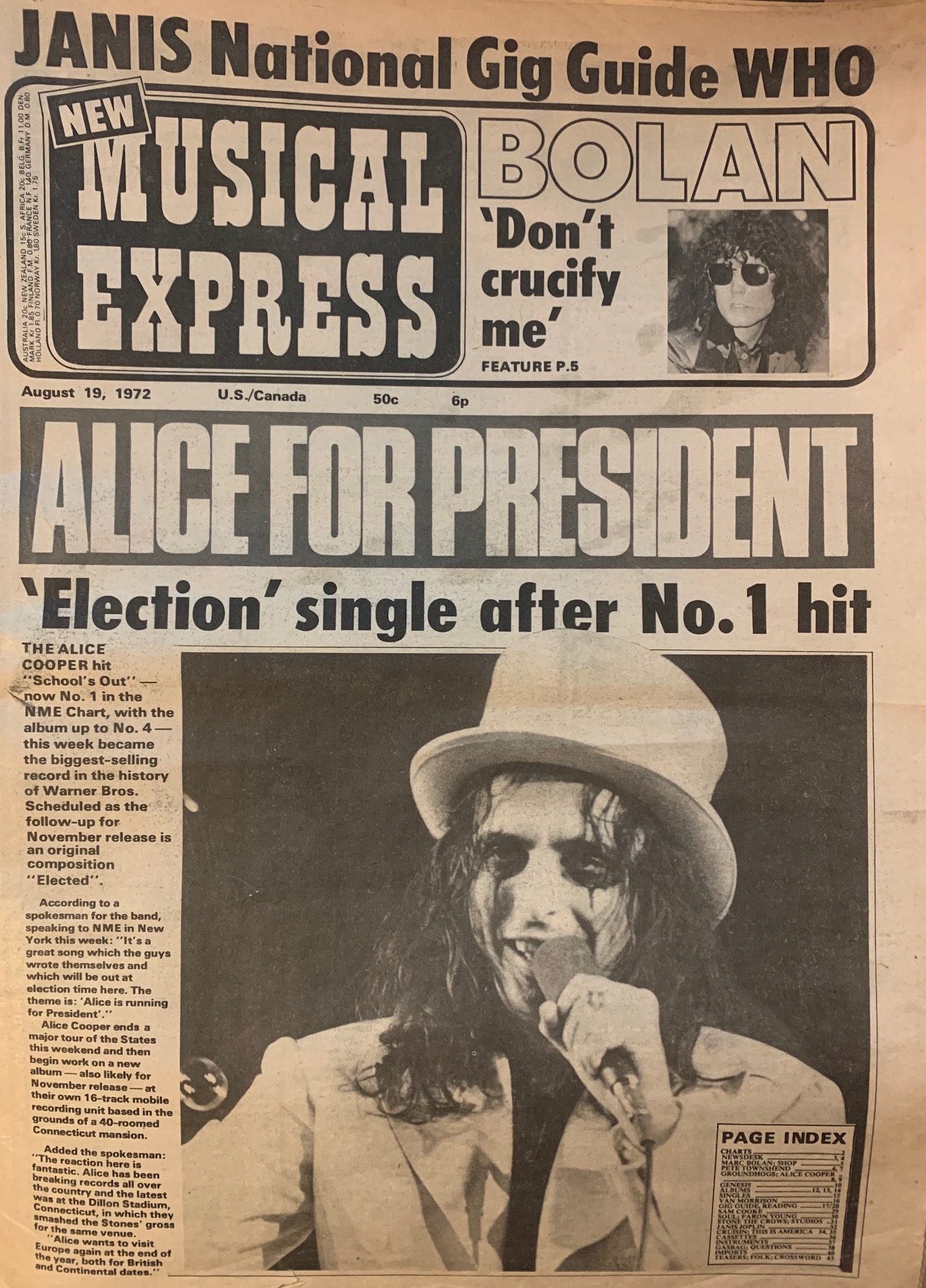
Article for MTV.com, 2016, On Alice Cooper's "run" for President in 1972.

Forty-four years ago, Alice Cooper ran for President.

Okay, not really – but the singer and his group did release the single “Elected” in September 1972, timed for the final stretch of the Nixon versus McGovern race for the White House.  A bombastic blast of proto-punk fury, “Elected” proposed Cooper as the leader of “a new party, a third party, a WILD party” that would “take the country by storm”. The single was accompanied with an uproarious promo video, in which Cooper drives around in a Rolls-Royce glad-handing the voters and revels in the barrow full of donor cash wheeled in by his campaign manager,  a roller-skating chimpanzee.

The idea for “Elected” actually dated back to the previous Presidential contest in 1968, which inspired Alice Cooper to write a song titled “You Shall Be Elected”. That lyrical concept fell by the wayside but the tune survived as “Reflected”, a track on the group’s 1969 debut album Pretties For You. Flash forward to ’72 and Alice Cooper were now the most infamous band in America, thanks to their shock-rock concerts involving the dismemberment of baby-dolls and faked but hair-raisingly realistic executions of the singer by gallows and guillotine. Following the chart success of “School’s Out,” the group were on the brink of the superstardom they’d been chasing for four grueling years.  So they decided to jump on the election-year bandwagon and drastically remodeled “Reflected” with the original lyric restored and intensified. Instead of “You Shall Be Elected”, the hook line became “I wanna be elected”: a messianic power trip for a singer who justifiably saw himself as a leader of youth.  

Bob Ezrin, the group’s producer, came up with a shrewd ruse to generate the declamatory demagogue vocal that “Elected” needed. “To get the performance I had a full-length mirror placed in front of Alice on an angle,” Ezrin told an interviewer. “That way he could see his entire body in reflection.” Gesticulating like an orator, Cooper rasped out lines about how the “kids want a savior, don’t want a fake” and vowed that very soon “we’re all gonna rock to the rules that I make.” Ezrin added horns suggestive of statesman-like pomp and distorted bursts of TV newscaster voice-over in the style of Walter Winchell. After $10,000 of studio time and eighty hours of obsessive mixing, the result was one of the hard rock classics of the first half of the Seventies.

From its whiplash opening riff through Cooper’s abyss-plunging scream to the portentous descending bassline in the outro, “Elected” can also stake a claim to be punk rock four years ahead of historical schedule. The tone of apocalyptic glee mingled with megalomania anticipates “Anarchy in the U.K.” (Johnny Rotten was a huge Alice fan and his audition for the Sex Pistols involved miming to “I’m Eighteen” on a jukebox). There’s a lyrical preview of punk too: during the fade, Cooper reels off a list of U.S. cities that have “problems,” then whispers “and personally... I don’t care” – a glimpse ahead to the taunting nihilism of “and we don’t care” in “Pretty Vacant.”

Listening to “Elected” recently while working on my new glam rock history Shock and Awe, I heard another element of prophecy:  Cooper’s drunk-with-the-promise-of-power performance reminded me of nobody so much as Donald Trump. Like Cooper, Trump is an entertainer moving into politics, using showbiz techniques that bypass reasoned analysis and policy proposals and instead conjure a baseless aura of authority. When Cooper rants about how “you and me together / young and strong,” it sounds like Trump’s blasts of hot-air about America being great again, how “we’ll win so much”. There’s Trump Tower-like bling too when Cooper brags about being “a dandy in a gold Rolls-Royce”.

Long before Trump ever featured in its pages, Alice Cooper made the front cover of Forbes. In the financial magazine’s April 15th 1973 issue, the band were held up as exemplars of “a new breed of tycoon” that had emerged thanks to the Seventies rock business’s bonanza of platinum albums and mega-grossing tours.  Beneath the headline “the rockers are rolling in it”, an interview with Cooper saw the singer describe himself as a true patriot: “I’m the most American rock act. I have American ideals. I love money!”  In another interview - with Bob Greene, a political journalist who followed his Nixon/McGovern campaign chronicle Running with a book documenting an Alice Cooper tour– the singer talked about his success in Trump-like terms as the result of a pure will to dominance: “It was nothing but positive thinking. I’m very competitive....  That’s my main life drive – being better than everyone else.”

 “Elected” was the taster for Billion Dollar Babies, the 1973 album that propelled Alice Cooper to mainstream megafame.  A brazen celebration of money-making, the album stomped on the last vestiges of hippie idealism still lingering on from the Sixties: instead of sticking it to the Man, why not become the Man?  Billion Dollar Babies’s packaging was styled as a snakeskin wallet bulging with cash; inside, fans found a facsimile of a billion dollar bill. The accompanying tour was the most spectacular and lucrative (raking in a then astronomical $4,000,000 for 64 concerts) that rock had yet seen. The group travelled between cities in a private jet with a dollar symbol on the plane’s tail.

In interviews Cooper described the album and the show as a celebration of decadence – then an in-vogue concept  because of the movie Cabaret. “It’s happening in the States now, all that German thing of the Thirties,” Cooper told Circus magazine’s Steve Demorest. “There is so much money in the U.S., and everyone has as much sex as they want. All we’re doing is reflecting it. I like the idea of the American Seventies producing a cabaret of over-opulence.... I’m a nationalist. I know the States is the best place in the world to live in.” Indeed Billion Dollar Babies concerts ended with the band unfurling the Stars and Stripes to the sound of “God Bless America”.

Dismayed pundits at the time took the commercial success of Alice Cooper’s sick-humor and cynical worldview as proof that the assumed link between rock and progressive politics had proved illusory. All those benefit concerts for McGovern played by rock bands had done nothing to forestall a landslide reelection for Nixon, self-proclaimed champion of the silent majority. Some critics outright identified Alice Cooper as Nixonian rock.  In truth, the singer had not even voted in ’72 – something he professed to feel ashamed about. But Cooper did say that “I wouldn’t have voted for McGovern”, mainly because the candidate was too wishy-washy and changed his mind so often. 

Generally, Cooper professed to find politics “so boring”, quipping that “if elected, I would impeach myself”. But while the finale to the Billion Dollar Babies concerts involved a Nixon lookalike bounding onstage only to be roughed up and bundled off by the band, in interviews Cooper expressed sympathy for the President,   embroiled in the Watergate scandal shortly after his reelection triumph. “I think Nixon’s got a rough job,” Cooper told Greene. “And if he’s guilty of anything, I don’t think it’s anything new. He’s just the first one to get caught. I think Nixon’s a star... He’ll go down as one of the biggest personalities ever to come out of the United States, just by being so notorious.... I would love to spend some time with him. I’d probably sit down and talk about golf.” That never happened but Cooper did get to play golf alongside Nixon’s VP and successor Gerald Ford in a celebrity tournament. In further bizarreness, one of the singer’s four homes was right next door to the Phoenix, Arizona residence of Barry Goldwater, hero of the conservative wing of the Republican Party and a failed Presidential candidate in his own right.   

Like the acting profession, rock has continued to lean left and liberal for the most part.  But the existence of right-wing rockers – Ted Nugent, Johnny Ramone, Kid Rock, Gene Simmons, Avenged Sevenfold, and Alice Cooper himself, who’s been described as a “quiet” supporter of George W. Bush but whose intentions in 2016 are undeclared– shows that there is no innate and irrevocable link between rock  and progressive politics. Indeed rock’s combination of populism and individualism arguably inclines more logically with a libertarian agenda than with socialism. 

When you look at the “rock star” version of rock - the model for misbehavior and excess that’s recently been so influential in rap – it becomes obvious that it has far more in common with Trump’s worldview than, say, Portlandia values.  “Rock star” rock runs on ideological-emotional fuel like vanity, wasteful splendor, and alpha-male display. There’s a reason why Trump soundtracks his stadium-concert-like rallies with songs like “We Are the Champions” and “I Won’t Back Down”, and why he could plausibly  add “We’re Not Gonna Take It” and “Don’t Stop Believin’” to the playlist too.  Magical thinking, vacuous self-aggrandizement, an appeal to gut feeling and irrational uplift, us-versus-them postures: if not the rock candidate, Trump is at least the hair metal candidate.

Although a Top 5 smash in the U.K., “Elected” did not repeat the success of “School’s Out” in America, stalling at Number 26. Let’s hope this is an augury for November.


Saturday, October 5, 2024

plastique fantastique

SOPHIE's posthumous album SOPHIE is out now on Transgressive and Future Classic - and there's some great stuff on it. 

An interesting piece at the New Yorker by Jia Tolentino looking at SOPHIE's career and work in terms of "plasticity" 

On "Bipp"

"black space latticed with radically strange objects: a rubbery squelch of a bass beat, a melodic line like a laser coated in latex, percussive punctuation marks that seemed to morph from plasma into steel."


On SOPHIE'S early interviews:

"She’d picked the name Sophie, she said, because it “tastes good and it’s like moisturizer.” Her influences were “shopping, mainly.” She wondered if music could work like a theme-park roller coaster, leaving you nauseated and laughing, then leading you to purchase a key ring."


On SOPHIE'S process:

"Nothing else sounded like Sophie, because she made her sounds from scratch. She didn’t sample; she built each hiss and smack and boom by manipulating raw waveforms. She wanted to get to the “molecular level of a particular sound,” to understand why that sound “behaves a certain way when processed or cooked.” 

On SOPHIE's ethos:

"There was a sense that transformation was the point and the teleology; Sophie’s sonic plasticity pointed to interrelational reinvention, toward a truth that had to be formed in the primordial tide pool of a dark, pulsing room...... She had translated her life and her questions into these new sounds, evincing some personal ethic of the transhuman and the trans human, in which states of flux could be captured in digital permanence, in which alteration was how you approached the divine".


^^^^^^^^^^^^^^^^

As I have said before here, if any artist could have had a lengthy entry in the "Aftershocks" section of Shock and Awe, it would be SOPHIE. Below are my thoughts about "Faceshopping" and Oil of Every Pearl's Un-Insides


"Faceshopping"  is a digi-glam tour de force. 


Here's what I said about the video-single in the infamous C-tronica piece: 

"The 2018 song and video works simultaneously as a critique and a celebration of the idea of self-as-brand, drawing inspiration equally from 21st century social media and from the tradition of flamboyant display in ballroom and drag. A digital simulacrum of Sophie’s face—already a stylized mask of makeup—is shattered and reconstituted using computer-animation effects.

Further thoughts:

... What intrigued me about SOPHIE is this collision of extreme exteriority but then still a lingering belief in the idea of interiority. 

In interviews,  SOPHIE sometimes used the words "authentic" and "authenticity" as positive terms 

Some say that the album title Oil of Every Pearl's Un-Insides is intended to be read phonetically - "I love every person's insides"

An idea continued on the album's other single "It's Okay To Cry", which contains the line "I think your inside is your best side" 

Again playing on the contradiction between exteriority and interiority: the photographable pose ("your best side") versus deep hidden truth ("your inside").

Between selfie and self. 

Tears as a tear in the 2D image presented to the world. The abject inside leaking out.

The Superflat SuperSelf.   Surface as Shield. An inscrutable mask.


So there's a tension that is unresolved between the allure of digi-glamour (creating doctored images  - selfies or videoworks - and disseminating them for unknown eyes) and a lingering longing to be real, to be unprotected and honestly vulnerable,  nakedly pathetic even.  Because the truth is always weakness and damage. 

That is further enacted in the songs not just thematically but in the sound itself - a combo of super-glistening surface sheen and hyper-contoured sounds versus messy splurges of sound and tearing, shredding percussion....

The immaculate  versus maculate (the latter sound-palette evocative of stress, abjection, fragility, torsion).

A sonic dramatization of a fraught mental space caught between the opposed demands of exteriority versus interiority ..   expressive also of an unresolved tension between the idea of the self as performative and constructed versus the idea of identity as innate and fated. 

"Dramatization" is the word  - with the kind of music made by SOPHIE and others, there's a feeling that the music is staged. You don't  immerse yourself in the sound, lose yourself in it; you almost look at it. It enthralls you, but you remain external to it, at a distance: watching it as a sonic spectacle. A ceremony. 

That's why the phrase "tour de force" feels right. It's hard for me to imagine someone listening to "Faceshopping" in a habitual sort of way. It's too imposing. More like a show, an event to experience  rather than something that can accompany  everyday activity.  

A flagellant pageant of ritual rhythm. 

The opening salvo of lyric, as delivered by Cecile Believe - 

My face is the front of shop

My face is the real shop front

My shop is the face I front

I'm real when I shop my face

- also makes me think of a book I read for S+A:  Erving Goffman’s 1959 study of social life as theatre The Presentation of Self in Everyday Life, in which he formulated concepts like “impression management” and the “personal front.”  

The song is a deeply ambivalent commentary on the culture of art-I-fice and self-selling - identity as product.

Today's digi-glamorous Instaglam  spaces - a honeycomb hall of mirrors infinity infested by influencers (people paid to be seen - seen with products) - is like a decentralized and democratic version of the royal court.  A placeless place to be, a poser's paradise.  A festival of facades. (No wonder that the courtly world loved nothing more than a masquerade).


  References to pearls and glam(our) inevitably makes me think of this song: 


Me on "Mother of Pearl":

"Just as “Every Dream Home” has a religious undertow, “Mother of Pearl” references goddesses and the Holy Grail. But the most significant aspect of the song is the choice of mother of pearl as the trope of perfection (as opposed to diamonds or gold).The subliminal association is with the Virgin Mother: the whole song revolves around the madonna/whore dichotomy. Mother of pearl, also known as nacre, is an iridescent substance generated by particular species of oyster and other slimy mollusks.  Nacre is found on the inside of the shell, or on the outer surface of pearls. This pearlescent shimmer-stuff is a real-world analogue for glamour: an optically dazzling patina produced by an abject, formless biological interior.   Virtually imperishable, nacre exists right on the edge between the organic and inorganic, the mortal and the deathless.  It suggests that there is something life-denying, or least life-freezing, about glamour. Reversing William Blake’s dictum that “exuberance is beauty,” glamour replaces liveliness with a cold, still perfection: the pose, the photograph." 


^^^^^^^^^^^^^

Thought for an essay: contrasting Poly Styrene and SOPHIE,  1970s rad-feminism and 2010s xenofeminism, "when I put on my make-up / the pretty little mask's not me" versus "Scalpel, lipstick, gel /action, camera, lights"

Art-I-Ficial


On X-Ray Spex and Poly in S+A:

"Marianne Elliott-Said picked Poly Styrene as her name as a “a send up of being a pop star... like a little figure, not me... a lightweight disposable product... that’s what pop stars are meant to be”. There’s an echo here of Bowie’s “plastic soul” and Ziggy as “plastic rocker”. As is the case with much punk, glam-turned-inside-out is what you get on the glorious Germfree Adolescents: tunes like  “Art-I-Ficial” cry out with a sort of jubilant bitterness, Poly unloosing her emptiness vengefully upon  a world that has made her generation inauthentic and  soul-less.  “Obsessed With You” blasts advertisers for whom every kid is “just another figure for the sales machine,” but also the impressionable, moldable kids; “I Am A ClichĂ©”' and “I Am A Poseur” reflect back at society its own worst nightmare of youth-gone-wrong. “Let’s Submerge” and “Warrior In Woolworths” lampoon the concepts of rebellion and the underground on which punk itself is based. “The Day The World Turned Day-Glo” and “Plastic Bag” are hallucinatory consumer phantasmagorias - “I eat Kleenex for breakfast and use soft hygienic Weetabix to dry my tears,” “1977 and we are going mad! 1977 and we've seen too many ads!”-  like “Virginia Plain” soured and psychotic. 


"Identity is the crisis can't you see..."


^^^^^^^^^^^^^^^^^^^^^^^^^^^^^^


Related fragment: 


"Fueled by narcissism, our century’s great motivator, the hipster inflicted himself upon the world by way of his affinities, his special brands of choice. Then we bypassed the middleman and became the brands ourselves. “Life has become a performance, a rather banal and meaningless one. That may have been the case for centuries, but even more so now,” wrote Dean Kissick for Spike Magazine in 2021. “The only thing we can make now is ourselves; day after day, again and again.” Not only is this life of endless bonsai-pruning one’s public-facing persona bleak on its own terms, it also comes at the expense of real and lasting art. Today’s avant-garde make memes or podcasts; they generate discourse; they post."

- Meaghan Garvey on indie sleaze at GQ.


Sunday, September 29, 2024

Metal Jacket Guru

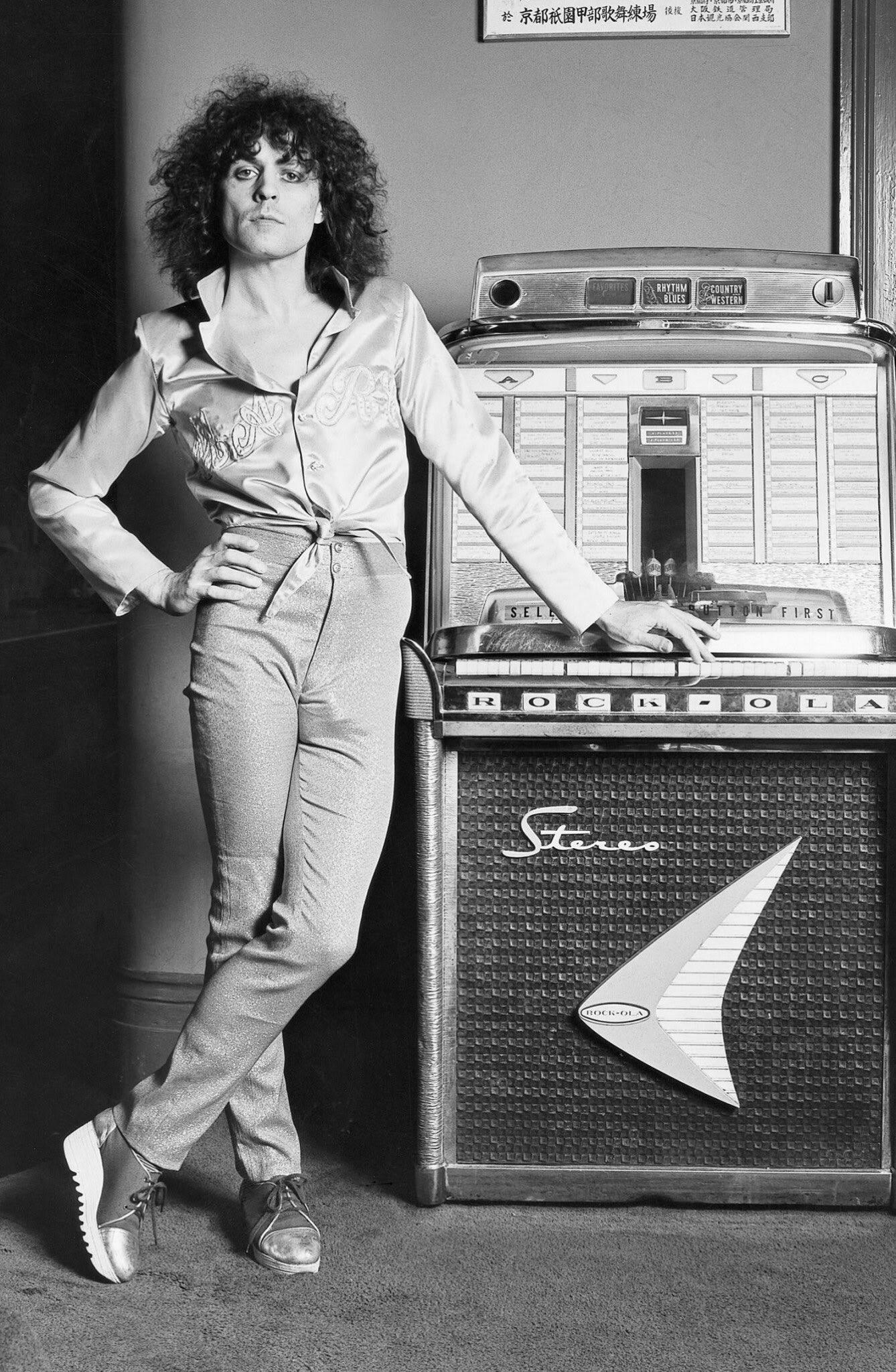
I have this sort of pop primal scene to do with seeing T. Rex on T. Vee.  A personal creation-myth based on Marc Bolan's audio-visual impact on my fragile eggshell child-mind. 

I first referred to this memory scar  as early as the introduction to Blissed Out - where it is described as  an early encounter with the Pop Sublime, a sensation that scared and spooked me as much as astonished and excited. 

There's a more developed account of how it blew my eyes in Shock and Awe's intro.  

"One of my absolute earliest pop memories is being shaken by the sight-and-sound of Marc Bolan on Top of The Pops singing  “Children of the Revolution,” or maybe “Solid Gold Easy Action” . It was the look of Bolan even more than the ominous sensuality of T.Rex’s sound that transfixed me. That electric frizz of hair, the glitter-speckled cheeks, a coat that appeared to be made of metal—Marc seemed like a warlord from outer space." 


"Children of the Revolution" was just a guess. It's a memory that is no doubt distorted and constructed to some degree. 

Mind you, when I saw this advert - circulated on Twitter by someone calling themselves Glam Rock Chris - I thought: actually that could be the very garment I saw as a nine-year-old -  the metallicized jacket.


 So "Children of the Revolution" could have been the song. 


Here's another startling contender - a coat of many colours, all of them ultra-glossy.  


Then again, some of the effect could have come from Top of the Pops loving to use these particular effects all the time - howlround was the name of one, if I recall right, a kind of video feedback effect I think. The whole screen would go a kind of metallic purple or pink or yellow, with the performers shrouded in this electric haze. Except that because we were watching on a black and white TV for the whole 1970s, what reached my retina would have been more like a solarized silver. So that could be the "metallic guru" effect right there. 

The Top of the Pops studio crew seemed to know that these FX were especially suited to glam and glitter groops - The Sweet, Gary Glitter et al - although you would get them on other types of groop sometimes and I have seen the FX used as late as X Ray Spex when they did "The Day The World Turned Day-glo" (where the plastique-fantastique aura would suit Poly Styrene's whole vision to a tee). The effect seems especially right for T.Rex because it is psychedelic yet also plastic and artificial in the 1970s vibe. 

Here in fact are  T. Rex doing "Children of the Revolution" on Top of the Pops, intermittently irradiated with a scarlet rinse (at 1.48 first). However the garment is a sort of tasselled, open-at-the-chest shirt. 


Okay, I think I've found it - and it's actually my other guess: "Solid Gold Easy Action" on Top of the Pops.

Marc's got a silver jacket and there's some howlround (I think) FX with a fierce turquoise hue. 


I think as a 9-year old I would have found the jolting rhythm of this song perturbating:  a Dionysian initiation.   

Today it's probably my favorite T. Rex song although "20th Century Boy", "Children of the Revolution" and "Get It On" are hard on its heels. 


On another subject - my feeds have been flooded with Marc Bolan images recently. It started with the 47th anniversary of his death. But because I always slow down and look and often save them (see below) the algorithm is inevitably shoving more and more at me. 

This is nice but I still think it's odd to

a/ commemorate someone's deathday

b/ do it on an odd-number anniversary. 


September 30th Update: and of course now there's even more images flooding the socials, because it's the anniversary of Marc's birthday today


An offcut from an early draft of the T. Rex chapter in S+A


The party was going to be legendary.  It was being thrown by a friend whose parents ran a boarding school near Ipswich and were away on their summer vacation.  The idea of this place of education being so deserted  and divested of  authority was powerful enough to pull us a considerable distance across England. Excitement mounted on the coach journey and the long walk through fields from the bus stop to the school.

But the build-up turned out to be more thrilling than the party itself. It took place in the headmaster’s house, as opposed to spilling riotously through the classrooms and into the gym (how I imagined it, a sort of sequel to If....). And while the party was packed, it consisted mostly of people milling around and drinking. Nothing  really ever happened. Certainly nothing like mayhem.  

Only two things stick in my memory about the night. 

One was attempting to sleep in a bath tub, like I’d seen in the movies, and discovering how  it doesn't work, how it's too uncomfortable. 

And the other was the boy dancing to T. Rex.

We were sat in some kind of side-room,  a little bored and not nearly drunk enough. And  then this young man, in his early twenties probably, put “Get It On” on the record-player and danced, sinuously and seductively.

I recognize the boy now as a type:  darkly luscious, willowy, imp-of-the-perverse glint in the eye. An English archetype, running from Syd Barrett and Mark Bolan, through Peter Murphy, Daniel Ash and other Goth male singers..... through the singer in Placebo... and then onto Noel Fielding.   

This boy wasn’t dancing as encouragement for us to join him, he wasn’t trying to get the stalled party started. He was dancing purely for display – splaying himself as an object for visual delectation, a plaything for our gaze.

I wasn’t turned on exactly, but I was entranced: at once admiring and envying the feline self-confidence it took to preen, prance and pose like that. 

A dance done in a mirror of people, the performance spoke to something inside me, in much the same way as the strange shapes thrown by another charming man, Morrissey, would, a year or two later on Top of The Pops.  

I knew “Get It On,” of course, but it felt like years since I’d heard it. 

T. Rex had been so massive for three years in the early Seventies that, like the Beatles and The Stones, they’d  never faded from pop consciousness altogether. 

But in the early Eighties, Marc Bolan wasn’t really present as a reference point or resource for current musicians, unlike David Bowie and Bryan Ferry, pervasive influences  throughout  New Pop and New Romanticism, from their vocal style and hair to their strategies and sensibility.  

Just about the only glimpse of Bolan-reverence in those days was when Bauhaus, the band fronted by Peter Murphy, covered “Telegram Sam”. But that was just a prequel to their more famous cover of “Ziggy Stardust”, which got them on Top of the Pops. 

 In 1983, singles by T. Rex and other glam groups were deejay favorites at The Batcave, the hub of the germinal Goth scene.  

But really, that was about it until later in the decade, when The Smiths put out some blatantly T.Rexy-sounding singles - "Panic" in particular -  while house producer Baby Ford attempted to refurbish “Children of the Revolution” as a rave anthem....


More 1980s T. Rexy vibes:


suggested by Tyler, horrid cover of "Children of the Revolution" by Violent Femmes


Love and Rockets pay homage with "So Alive"


Sounds like a sister song to the Sopranos theme


Okay this is more like 1991


"filthy cute and baby you know it"

Applause without ears

Came across this review of Shock and Awe online and was reading it, nodding along and thinking ' this is rather perceptive'   and t...