Recently I watched this fascinating documentary The Disappearance of Shere Hite, about the sex researcher and best-selling author.
I only had a vague sense of Shere Hite prior to watching the doc. Faint memories of two books: the famous one, The Hite Report: A Nationwide Study of Female Sexuality, a multi-million-selling, translated-into-dozens-of-language smash success on publication in 1977; and then the not-so-good-seller sequel about male sexuality published in 1981. I knew that she fit somewhere in that lineage of sexologists who shocked the strait-laced with their discoveries, alongside Havelock Ellis, Alfred Kinsey, and Masters & Johnson.

But really the main thing that comes to mind - and "come" is the operative word - is "Hite Report Disco", a raunchy spoof song that appeared on National Lampoon's That's Not Funny, That's Sick - a risqué comedy album my brother bought and which got played endlessly in our house. Such that many of the sketches I can remember word for word. I could certainly replicate the way the just-post-orgasmic man in "Hite Report Disco" says "grrrrrreat!!!" and the aggrieved tone of his unfulfilled lover muttering "great for you maybe".
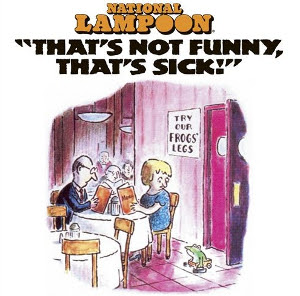
(Although listening to the song again, the National Lampoonists have failed to grasp the import of Hite's discoveries - the unsatisfied woman in "Hite Report Disco" really ought to take business into her own hands if she wants results)
The most striking thing about this documentary is not the disappearance aspect (her fading from fame and what followed). It's, well, the appearance of Shere Hite.
You expect some kind of fairly frumpy scientist - unconcerned with the fripperies of personal appearance - or at most someone respectably dressed in reasonably smart professional clothing.
But instead here's this absolute glamour queen clad in clothes that are decidedly
un-1970s, harking back to some much earlier idea of elegance and chic.


With her creamy complexion, piercing blue eyes, tall and willowy figure, and cloud of strawberry blonde hair, Hite looks like a Fassbinder heroine.


The name "Shere Hite" itself seems like some quintessence of glamour - "sheer" indeed.

It's like a movie star name, from the 1940s.

Even in her early pre-fame days, when she was struggling to make ends meet, Hite loved to surround herself with exquisite things - beautiful clothes, beautiful decor, beautiful furniture and ornaments and pictures.... all in a style of opulent luxuriousness dating back well before mid-century modern aesthetics... back to the Golden Age of Hollywood - the sort of dated sense of elegance and feeling for the "finer things in life" you'd associate with Norma Desmond.

I don't recall it being mentioned in the doc, but I'm sure Hite loved perfume - she must have wafted behind her the heady scent of the most classic and expensive fragrances

In the early days of her research, which was under-resourced but expensive, involving the mailing out of thousands of surveys and then the painstaking collating of the highly detailed data that arrived in response to the large number of questions... in order to keep herself subsisting (and perhaps also maintain some of her expensive habits), Hite worked as a fashion model.

She also was a life model for the illustrator Robert McGinnis, a collectable cult figure renowned for his movie posters and pulp paperback covers. Hite has been described as McGinnis's muse: she was his favorite model and her posed image proliferated in endless painted variations as the stylized glamour girl on the front of all kinds of romance, crime, and spy novels.... the kind of pink or orange edged paperbacks you used to find at airports or in the rotating racks of a convenience store or gas station....


Yet despite not just propagating - but clearly being personally enamored with - all these increasingly behind-the-times and reactionary images of femininity (the very sort of imagery and archetypes that Betty Friedan and German Greer, with The Feminine Mystique and The Female Eunuch respectively, wished to demolish) - despite posing for Playboy... Hite was a committed feminist, involved in the women's liberation movement via N.O.W.... a participant in demonstrations and activism... and independent-mindedly and determinedly dedicated to her research into female sexuality,

That work was demystification in the Our Bodies, Ourselves mode - about exposing the
graphic genital truth of female sexual response, the fleshy facts of the mechanics of orgasm.


The gulf between the two fronts of activity - the surface illusion, the carnal truth - is fascinating. As is the way that she pursued both with the exact same degree of passion.
Not for her the throwing of cosmetics and brassieres and lingerie into the Freedom Trash Can, as done by second-wave feminist agitators New York Radical Women at their Miss America demonstration.

Hite would have been "what a waste of good beauty products!"
She was at once feminist and post-feminist (or is it pre-feminist?).... affirming the mystique of femininity as another form of power... accepting the idea that gender is a performative construction...

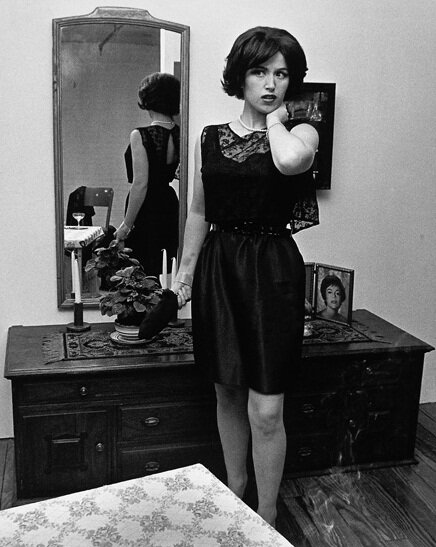
The fashion and illustration work in an odd sort of way reminds me of Cindy Sherman... True, she was not the auteur of these images, McGinnis was... but Hite was something close to a collaborator in that body of work... as she was with the pictures above, and below, done with the German photographer Iris Broch.

The photographs of Hite, and the book covers based on her image, are like the material, the archive of archetypes and poses, that Sherman recreates for her work.


"Others might try to break open that web of mirrors, but Sherman's way of revealing it is just to keep on skilfully turning the kaleidoscope where a few fragments of fantasy go a long way"
- Judith Williamson, Images of 'Woman', 1983


Second only to the Republican Christian women who sabotaged the Equal Rights Amendments, the Swans were the high-profile anti-feminists of the era - trophy wives whose entire lives were dedicated to conspicuous consumption, socializing and society events, gossip, pecking-order disputes.... and affairs. These were often accomplished and brilliant women, but their abilities were penned entirely within the domain of appearance - their own physical appearance, which was immaculate and expensively achieved, but also social appearance: maintaining the facade of a perfect life. (Okay, there was a bit of noblesse oblige philanthropy and that kind of thing - as much done for show as for altruism). There was a rigid and total specialization of roles within the marriage: the wives handled all the inessentials that make life pleasant, while the husbands got on with the business of running the world.


.jpg)
.jpg)